

How Can We Accept Change?
And When Should We Not?

Dear Classical Wisdom Reader,
One of the few constants in life is change…and yet… it remains one of the hardest realities for us to accept.
Why do we wrestle with this fundamental truth?
We resist the inevitable marks and mirrors of age, buying into the siren calls of the beauty industry, lured by false promises and expectations from the celebrity class. And yet, those wrinkles, whether we like it or not, will come, along with grey hairs and the ceaseless effects of gravity.
We marvel at the evolution (or devolution, depending on your perspective) of speech: the conjuring of new concepts and meanings in everyday language employed by younger generations… ones that increasingly become completely undecipherable (to us at least).
We watch as our communities change: the old neighborhood shops and restaurants close and new ones open; familiar local faces disappear while ambitious leaders rise; even the seasons and the weather vary within a day, a week, a year, a lifetime.
Change is inevitable...something the ancients observed and knew well.
The Ancient Discovery of Flux
Indeed, we can go back to the Natural Philosophers* of the 6th century BC…
(*More commonly known as the Pre-Socratics. Regular readers know that your editor has something of a bugaboo about this term, which unjustly relegates these profound thinkers to the status of proto-philosopher…a mere philosophical footnote! So let us instead refer to them as Aristotle did…)
In particular, we turn to Heraclitus (c. 535 – c. 480 BC), the misanthropic, cryptic poet-philosopher who wandered the hills of ancient Ephesus contemplating the nature of the world in general, and the reality of change in particular.
You may remember him from such phrases as “everything flows,” “war is the king of all,” and “man cannot step into the same river twice.”
In fact, the latter phrase has been summarized and recorded in a few different ways. Perhaps the most genuine comes from Arius Didymus, preserved by Stobaeus, which reads as follows:
“On those who step into the same rivers, different and different waters flow.”
At the heart of Heraclitus’ often obscure and linguistically dense philosophy is the concept of flux, that everything is always, and forever, changing.
This is one of those delightful and rare situations in which a philosophical idea might at first appear esoteric and abstract, yet turns out to be deeply tangible and accessible.
Of course everything changes, as a few moments of peaceful observation and careful contemplation confirms…

What was truly brilliant about Heraclitus, beyond his knack for epic and memorable phrases that beautifully encapsulate universal truths, is that he understood change not only as something that happens to the world around us...but as something that happens within us as well.
You Are Not the Same Person You Were
Again, this is anecdotally evident. If you are really hot and thirsty, water tastes better. If you have been cold all day, a warm room feels luxurious. Music sounds different when you are heartbroken than when you are in love; silence can feel oppressive in loneliness and blissful when you are overwhelmed. The same object, the same sensation...yet an entirely different experience.
But I’ll let Heraclitus speak for himself:
“Disease makes health sweet and good; hunger, satiety; toil, rest.”
(Stobaeus, Florilegium)
You will change. You have already changed. And you will change more. Not just physically, either, but in your perspectives, priorities, and circumstances.
I recall, for instance, being in my 20s and feeling frustrated that parks had gates around them. They hindered my walking route, and I felt less safe in the evening, knowing I might not be able to leave easily should I feel threatened.
But then, in my 30s, raising a young child who happily played tag with friends around the same park, I praised those very gates for keeping her safely inside and away from the street.
Same park. Same gates. Different Anya.
You can apply this perspective shift to just about any topic, cause, or belief. Our age, social situation, and sense of obligation or duty heavily influence our stance on even the most controversial subjects.
Just think how being able to bear children, or being eligible to go to war, might affect your decisions and convictions.
When Things Become Their Opposites
But there is more...another crucial insight from the so-called “Obscure” philosopher.
Not only is change a given, both from within and without, but everything is also always in the process of becoming its opposite. At first, we might be suspicious of this claim...until we consider that each morning we rise from a dreaming state to being fully awake, we rinse and let our wet hair become dry, while our morning coffee, if we don’t drink it fast enough, turns from hot to tepid to cold.
This principle isn’t confined to our morning routines. It applies to larger movements and cycles as well.
Consider political parties, for instance, which have become their opposites time and time again: once champions of peace, later advocates of war; initially committed to restraining power, later seeking to expand it; once representing the working class, later dominated by elites.
Likewise, powerful countries grow weak while others rise to dominance. Empires collapse into republics; revolutionary movements harden into the very institutions they once resisted.
Even technology follows this pattern: inventions designed to save time end up consuming it, and tools meant to connect us can, paradoxically, leave us feeling more isolated than ever.
Why We Resist the Inevitable
The truly amazing thing is not that change is always happening, it’s that we are so resistant to it.
Change is reality, and yet we rail against it with astonishing determination.
There are many reasons for this. Psychological research shows that we are pattern-seeking animals who cling to stability out of inertia, bias, and a deep fear of loss.
But I would also contend that we resist change because of a false sense of a continuous, fixed self. If we acknowledge that change is occurring all around us, we must necessarily extend that principle inward. And yet, how can we become our opposite and still remain ourselves?
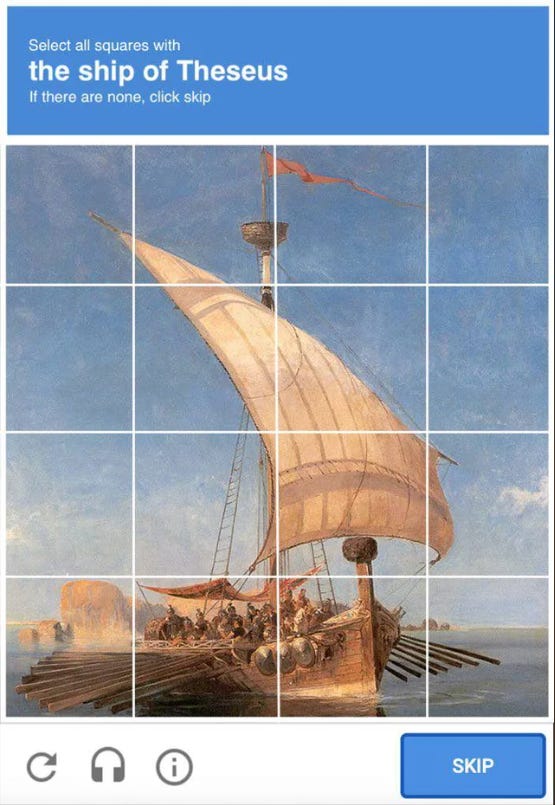
How much of our identity is composed of our ideas, thoughts, and beliefs? And if those are continuously changing, do we still stay the same?
This notion runs counter to a modern world increasingly built on ego, branding, and rigid self-definition... something regular readers may recall from last week’s mailing.
Accepting Change and Knowing When to Resist
This brings us to the question at hand, dear reader.
Change, as we have seen, will happen. We simply cannot keep the living, breathing world static...like a museum piece, carefully preserved behind glass. And yet, we also know how difficult it is to see this clearly, let alone make peace with it.
At the same time, accepting change is essential for growth and genuine transformation.
So how do we do this?
How can we accept change and go with the flow?
In what ways can we embrace the flux?
And when, if ever, should we resist it?
I want to hear your thoughts, as we all approach these universal questions from very different places and moments in our lives… Comment below!
All the best,
Anya Leonard
Founder and Director
Classical Wisdom
This idea of becoming our opposite is incredibly powerful. I feel like that warrants an article in itself — it’s like we stare at the things we hate so long that our faces mirror them without us even realizing it.
Thanks for the interesting thoughts on change and its effects on how we view ourselves! I find the fallibility of memory to be an immensely complex and interesting subject relevant to this discussion.
"The bureaucratic mentality is the only constant in the universe." - Dr. Leonard "Bones" McCoy