

Do “I” Matter?
Ancient Wisdom for Modern Egos

Dear Classical Wisdom Reader,
If you have had that distinct feeling that society as a whole has become more and more self-obsessed and self-orientated, don’t worry, it’s not in your head.
The shift is very real, very visceral, and impressively broad, stretching across culture and taking shape in a myriad of forms, some more obvious than others.
Fortunately for us, the ancient world is very good at shining light on modern messes.
But first, the problem...
A Culture of Me, Myself, and I
Let’s start with the elephant in the room: the rise of social media.
Bios, grids and feeds have essentially become full-blown self-identity billboards that not only advertise the self, but have evolved into a daily ritual of self-narration: a constant contemplation of how best to curate, refine, and project the exact version of ourselves we want the world to see.
Instagram and TikToks now read like micro-manifestos. Rather than simple snapshots of life, they are declarations of identity with pronouns, mental health notes, political stances, complete with “healing era,” “soft life,” and “main character energy.”

This naturally extends into influencer and ‘personal-brand’ culture. We follow individuals who overshare their lives, instead of committing to communities, groups or shared institutions. Once we joined bowling teams. Then we bowled alone. Now, we seldom even leave the house, bowling be damned!
Perhaps somewhere, someone is “liking” a photo of bowling...
Politics, too, has quietly migrated from the realm of public debate into the realm of personal identity. Once a shared civic concern, a collective attempt to improve community life, political beliefs have increasingly become badges of selfhood. Posting the right slogan, flag, or stance often signals moral identity more than it advances collective action.
Even language reflects this shift. Therapy speak, language designed for private reflection, has seeped into everyday discourse. Phrases like “I’m protecting my peace,” “this doesn’t align with me,” or “I’m holding space for myself” center the self thoroughly, even in situations that used to emphasize compromise, obligation and responsibility.
And then there’s music, an excellent and dare I say, honest cultural mirror.
Here we actually have numbers. Several peer-reviewed studies have analyzed song lyrics across decades and found a measurable rise in first-person singular pronouns (“I,” “me,” “my”) alongside a decline in collective language (“we,” “us,” “our”). A major study by DeWall, Pond, Campbell, and Twenge (2011), analyzing Billboard hits, confirmed this trend — and it has been replicated repeatedly in 2019, 2021, and 2024.
In short: the soundtrack of our lives has become increasingly about “me.”
Perhaps a poignant example is Gotye’s “Somebody I Used to Know”, which admittedly begins with what seems like a post breakup whine-a-thon, only to transform into a genuine duet, beautifully illustrating the complexities and differences of opinion between two people regarding the same event (their breakup)...
Contrast that to Doechii’s more recent “Anxiety” song, which turned Gotye’s duet into an ode to her own emotions…
So yeah, if you recall the music of your youth being about stories, ideas or, dare I say interesting things beyond “me, myself, and I,” well... you aren’t wrong.
Unfortunately, when putting all the above together, it paints a culture where the self is always front and center. However it’s curated, explained, defended, and validated, it’s clearly crowding out the older focus on shared meaning, duty, and community.
Of course, it’s hard to be immune to the encroaching wave of self-focus when it’s so all encompassing... but that’s exactly why it’s worthwhile taking a step back to contemplate: how much does our ego really matter?
That was a question that was of great importance to the ancients.
The Ancient Suspicion of Ego
The Greek and Roman philosophers cared a lot about the self... just not in the modern “ego-first” way we typically mean today. For them, attention to the self was meant to discipline, limit, and align the ego with something larger. You know, those things like virtue, reason, nature, or the community...
Socrates, for example, famously said “know thyself,” but he didn’t mean self-expression or self-esteem. He meant examining your desires, motives, and ignorance so you don’t become ruled by them.
The unexamined self was dangerous...not special.
Plato agreed that the ego was something to restrain. He divided the soul into reason, spirit, and appetite and believed a good life meant reason ruling over desire. Letting appetites like status, pleasure, and pride (all that “good stuff” that makes a popular social media account), take over was a moral failure, not authenticity.
Meanwhile, Aristotle had a more grounded take. He believed healthy self-respect was necessary, but always within virtue and community. Humans, he said, are political animals, you literally can’t flourish alone.
For the man who championed the doctrine of the mean, excessive self-focus wasn’t confidence; it was imbalance. So, yes, you can care about yourself, but only to become better for the world you live in, not more absorbed by yourself.
And this is the moment when we bring in the Stoics, because their stance on this topic is both famed and famously more harsh on the ego.
Stoics, Buddhists, and the Art of Shrinking the “I”
They argued that obsessing over the self, whether it’s how you’re seen, what you own, or how special you are, is a fast path to misery. And the reason for that is simple: most of that is outside your control. So, according to the Stoics, the solution isn’t self-love but self-mastery: focus on your character, your actions, and your duty to others.
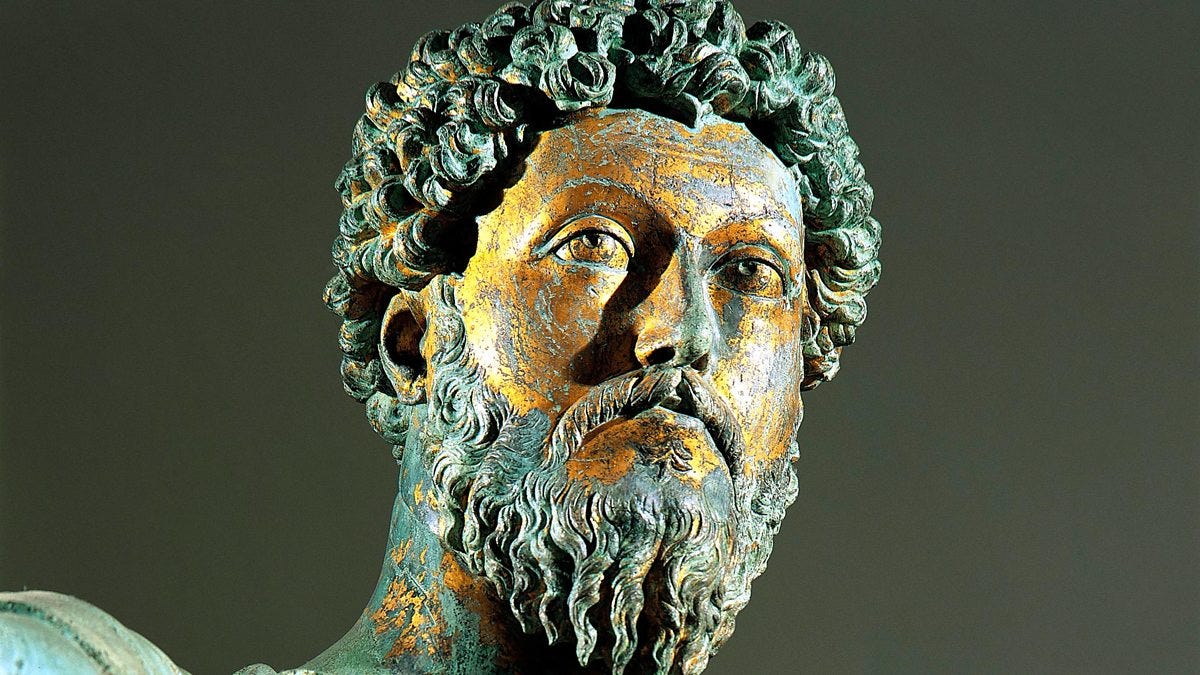
Marcus Aurelius reminds himself, repeatedly, that he is tiny in the universe, fame is meaningless, and other people matter just as much as he does.
But if we’re talking about dissolving the ego entirely, Buddhism takes the cake.
Traveling east, the Indian philosophy and religion goes even further by questioning whether the ego really exists at all. The Buddha’s core insight is anattā (non-self), the idea that what we call “I” is a temporary bundle of sensations, thoughts, and feelings...not a fixed, independent entity.
Gautama Buddha taught that clinging to the ego, our identity, desires, stories about who we are, is the root of dukkha (suffering). The more tightly we grip the self, the more anxious, defensive, and dissatisfied we become.
Instead of strengthening the ego, Buddhism trains people to observe it, loosen attachment to it, and eventually see through it. Compassion naturally follows, because when the “I” softens, the boundary between self and others does too.
So… How Much Should “I” Matter?
But is complete ego-dissolution the best path?
After all, one could argue that individualism has played an important role in progress, that competition and self-driven ambition has spurred on and fueled innovation and development in the Western world.
And so, dear reader, I turn the question over to you...
How much do “I” matter?
Should we follow the ancient philosophers? Plato and Socrates? Epictetus or Epicurus? Or go all the way with Buddha?
How much should we focus on the Ego? On ourselves?
As always, be a part of the Classical Wisdom Community and join the conversation below!
All the best,
Anya Leonard
Founder and Director
And please remember, you don’t need to ‘bowl alone’ here! Subscribe to take part in our Classical Wisdom Community, bringing ancient wisdom to modern minds across the world together:
Very helpful discussion. Aesop may increase the insight here. The Ox-driver and Herakles story where, after the wagon fell into a deep ravine and the driver stood, without doing anything, invoked Herakles. Herakles appeared and said:
‘Put your hand to the wheels, goad the oxen, and do not invoke the gods without making some effort yourself. Otherwise you will invoke them in vain.’ As Martin Buber reminds, we exist within ourselves and our realization (actualization).
Eternal return.
The Buddha did not only say that we should not cling to the ego, he said that it does not exist as a lasting entity. On the other hand as it is largely a social construct, we should not either walk into the traps of the society we belong to. The Buddha was a non-conformist + sympathy (cum-passio) rather that "charity" or love for our human species.