

Can We Find the Real Ithaka?
In Search of Homer and the Meeting of Like Minds

Dear Classical Wisdom Reader,
I have two regrets from Saturday. First, I did not get the opportunity to speak with everyone as much as I wished, and that includes our guest lecturer, the famed translator and charming author, Emily Wilson. All the guests were so fascinating and thoughtful! It was clear that one day was woefully insufficient to plumb the depths of interesting conversation.
The second was I didn’t take nearly enough photos. I did take some fortunately earlier in the day while we traversed the iridescent Melissani Cave, the mythological cave of the Nymphs (which you can see below)…but with nary a phone in sight during the final dinner, we are missing some key group snaps. Instead the discussion flowed enthusiastically, as did the local Cephalonian wine.
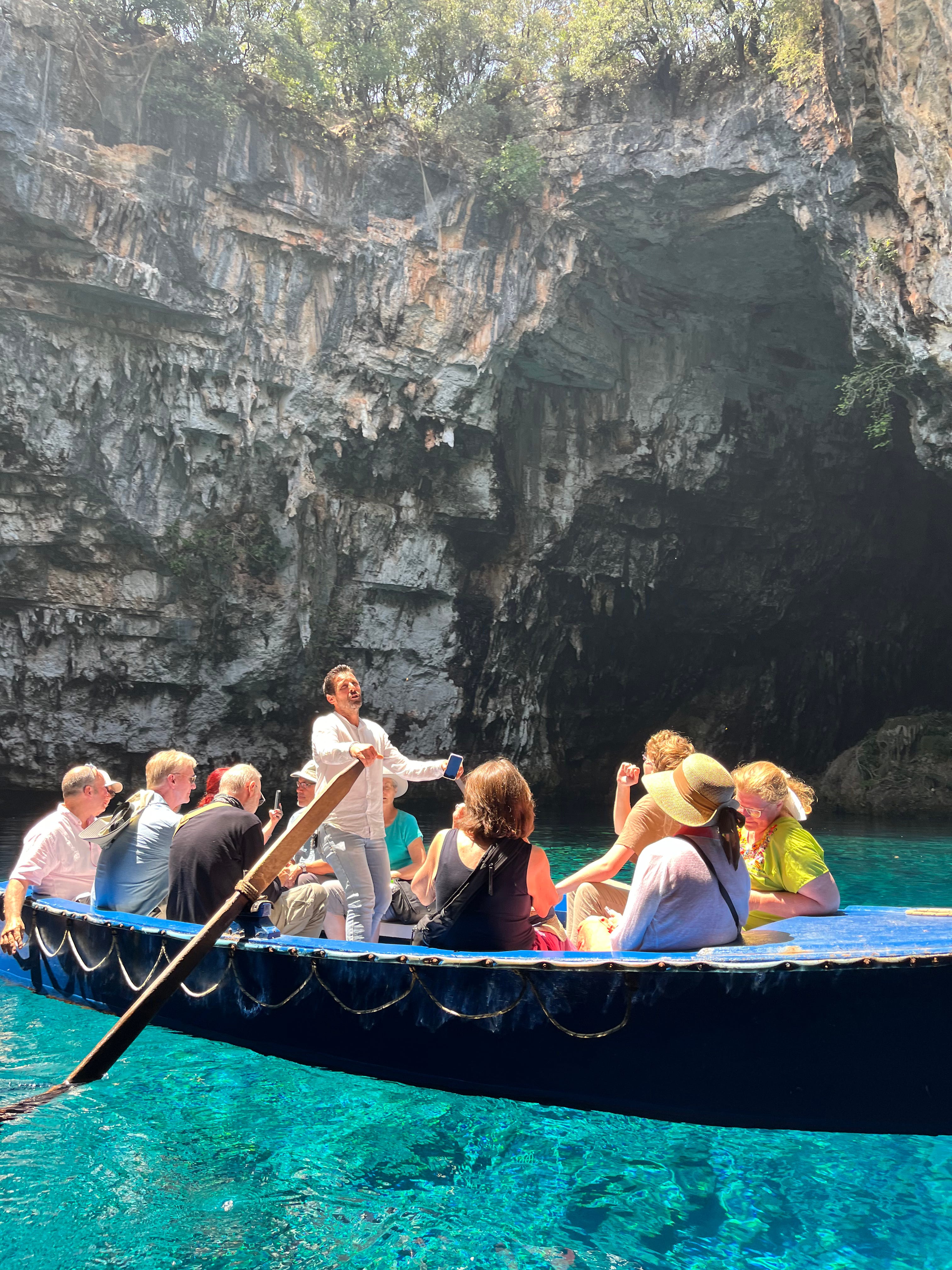
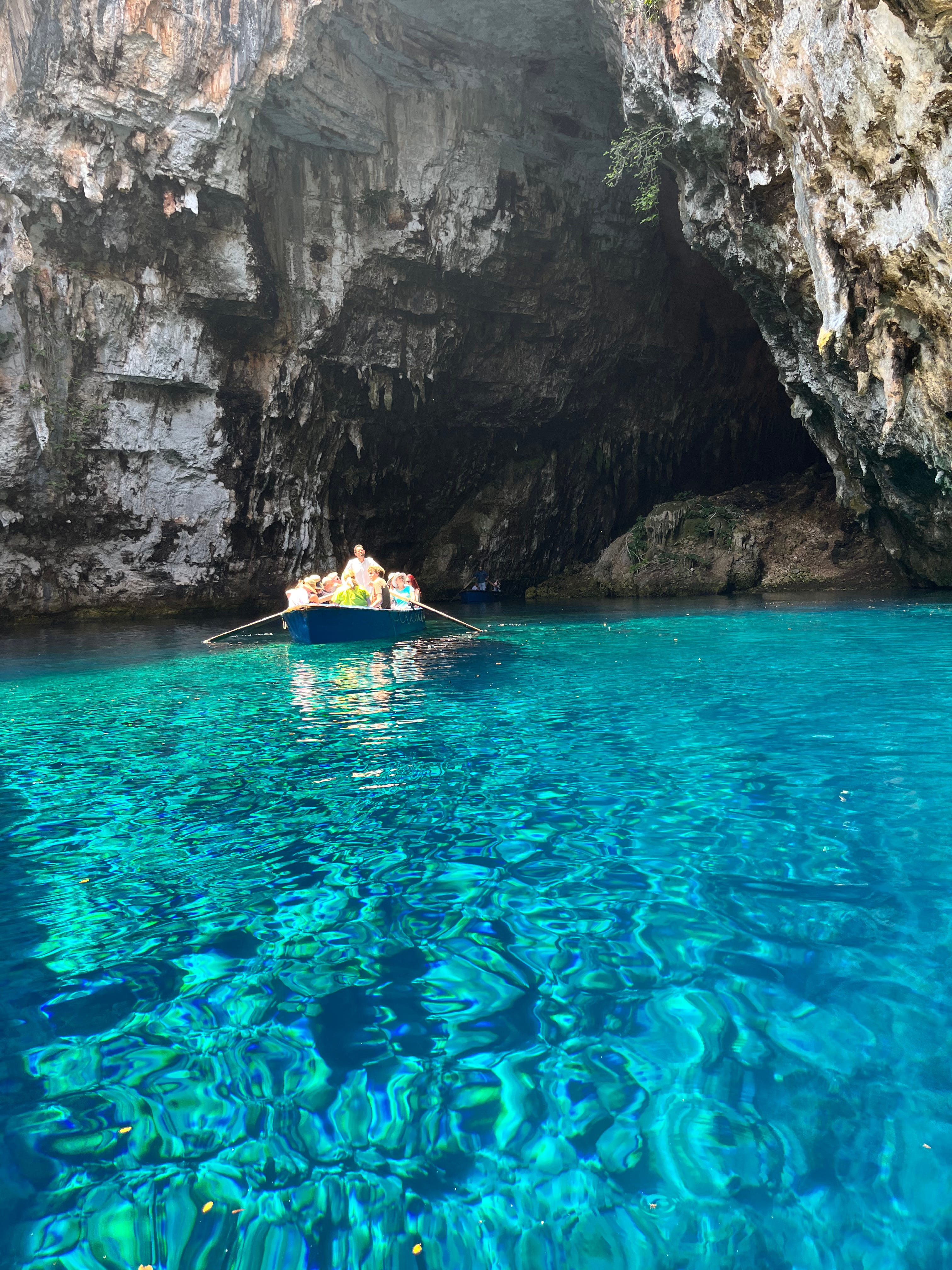
We joined the Classical Wisdom In Search of Homer voyage on their ultimate day... and after their 10 day excursion across the Hellas, undoubtedly an Apollonian endeavor and exploration, they were ready to complete the journey with a Dionysian evening.
Bacchus inspired celebrations continued to the very wee hours of the night... and fortunately no heads were lost (though it may have felt that way the next day...)
Clearly we didn’t want it to end! Being a witness to the Classical Wisdom community, in flesh and blood, was exhilarating. We regularly sit, my little family, with laptops at the table, typing away to a seemingly faceless crowd... but to eat, drink, and break bread with our wonderful (and wonderfully interesting) readers was honestly a bit surreal. After all, we have to spend so much time online, we’ve almost forgotten how to interact in the real world! But it’s awesome to hang out with like-minded lovers of wisdom and to know -to really appreciate- that actual people exist on either side of the ethernet cables.
To experience all that with the stunning backdrop of the Ionian Greek island, Cephalonia, was the cherry on top! After all, the trip was In Search of Homer... and some contend that Cephalonia is none other than the home of Odysseus.
But can we even find the locations in the ancient myths? Today’s special guest article by the acclaimed author Emily Hauser explores this question... specifically with regards to finding Ithaca.
***Classical Wisdom Members: you may recall our Podcast with Professors, featuring Emily Hauser, came out just last week! If you haven’t already, check it out and discover a fascinating new perspective on how we can understand the women in Homer’s world:

If you aren’t a member yet, make sure to join our growing community to enjoy all our resources, including our Member’s Only podcasts, magazines, ebooks and more...
Now... did the locations of Homer’s islands truly exist? And are we writing from one today? Read on and let me know what you think below!
All the best,
Anya Leonard
Founder and Director
Classical Wisdom
Mapping Myths: Are imaginary islands meant to be mapped?
By Emily Hauser
When Christopher Nolan’s upcoming Odyssey (2026) was announced, it was described by Universal Pictures as, “a mythic action epic shot across the world”… But where is “the world,” when you’re talking about imaginary places? Where exactly are the many fantastical islands of Odysseus’ epic return journey back from Troy which is narrated in Homer’s ancient epic, the Odyssey? And is it even possible to put dog-headed six-necked monster-women and goddesses who turn men into pigs on the map?
In other words: is it only the magic wands of Homer and Hollywood that can bring imaginary islands to life?
…Or did the locations of the epic Odyssey once, in fact, exist?
This is a question I have thought hard about in my latest book, Mythica: A New History of Homer’s World, through the Women Written Out Of It, which leans pretty heavily on that same word – “world”. I take the lead from the latest advances in archaeology and scientific discoveries to uncover the real women who influenced and inspired the legends of the Trojan War and Greek myth which came to be canonized in Homer’s Helen of Troy, Circe, Calypso, Penelope.
It’s a fascinating, epic journey that takes us from the ruins of the actual ancient site of Troy, tracing Odysseus’ legendary journey past nymphs and goddesses and monsters and princesses and queens – all women – on the hero’s way home. It puts, for the first time, the real women behind them, the incredible weavers, fierce women warriors, and waiting wives of the ancient world, back onto the map.
But the question is: if we’re going to throw around those kinds of words – world, map – we’ve got to think hard about what that means in the context of places where magic and mythology and geography collide.
Take the island of Circe, for instance, which Homer calls Aiaia. Geographers and Odyssey-enthusiasts have argued for centuries (literally) about where Circe’s island might have been. In Homer, Aiaia seems to be somewhere vaguely in the far east... and this makes sense, given Circe’s parentage in the epic; she’s a daughter of the sun-god Helios and granddaughter, via her mother Perse, of Oceanus, the encircling river-god.
But as history went on and the hunt for Homer’s islands started up in earnest, ancient scholars and commentators started to put her not in the east... but in the west.
As Greeks began to explore west and colonize settlements in Italy, it came to be suggested (as settlers often did) that they had heroic ancestors going all the way back to the progeny of Circe and Odysseus. ‘Monte Circeo’ – a lush mountainous promontory between Rome and Naples – came to be connected with Homer’s enchanting goddess. In other words, it helped Greek colonists to come up with a legend that Circe herself might once have lived on the Italian coast because it offered an origin story to suggest that, in fact, thanks to Odysseus’ year-long stay (and sex) with the goddess, they’d been Greeks there all along.
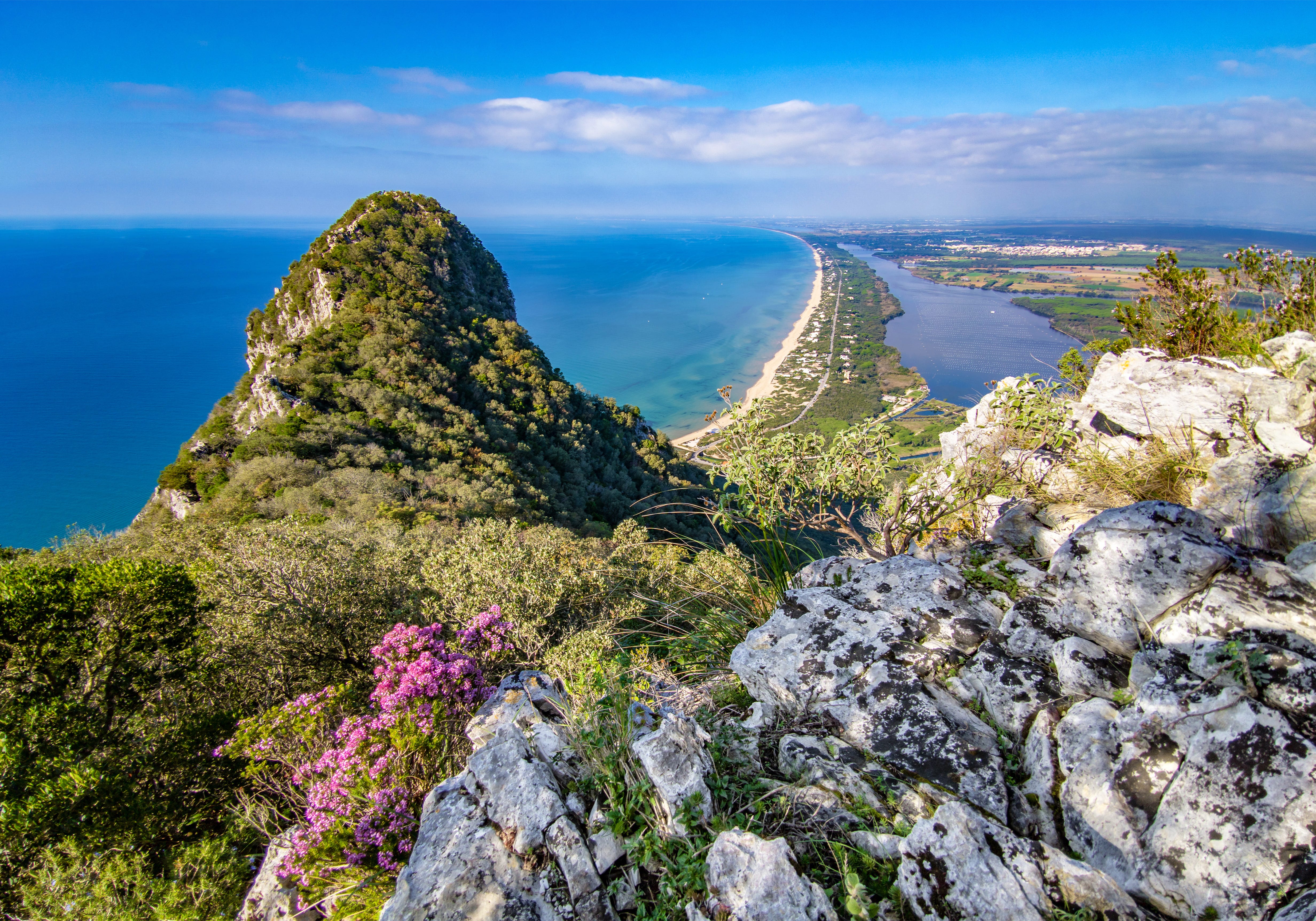
In this case, mapping the Odyssey’s women is as much about bolstering ancient (male) colonists’ claims to have a connection to Homer and Odysseus as it is about trying to find real locations. But what’s astonishing is that the latest discoveries in geology and new theories are actually uncovering fresh evidence for the actual locations of the Odyssey, and (crucially) its women, all the time.
One of the most exciting scientific mappings of the Odyssey is one that’s ongoing. It’s an investigation for an Odyssey location that is very much in the making: the search for Ithaca, Odysseus’ island home where Penelope waits for her husband for twenty years and towards which both the legendary voyage of the epic, and the narrative of the plot, aims. It’s when Odysseus gets home and is restored as Penelope’s husband and king of Ithaca that the narrative of the Odyssey resolves. It’s to Ithaca and to Penelope that he’s homeward bound – that, through all the monstrous women and spellbinding nymphs of his voyage, he wants and needs to return.
The location of Homer’s Ithaca has always posed a bit of a problem to Odyssey-hunters (and there have been a fair few...even the British Prime Minister, William Gladstone, got involved at one point). At first glance, it doesn’t look like there’s a problem at all. There’s an island to the west of Greece, among the Ionian islands, whose modern name is Ithaki: a fairly obvious candidate. But the issue is that it doesn’t match up with Homer’s description at all. Homer gives us three key clues for the location of legendary Ithaca in the Odyssey: low-lying, one of a group of four islands and furthest to the west of that group. Modern Ithaki, meanwhile, is extremely mountainous, one of three islands, and furthest east.
You might be tempted to say at this point that Homer might have mixed up his left and his right (after all, if the story of Circe’s Aiaia tells us anything, it’s that east and west look to be supremely interchangeable to ancient geographers). But, in 2003, a British businessman called Robert Bittlestone decided to take the ancient epic at its word. What if ancient Ithaca – Penelope and Odysseus’ Ithaca – really was furthest to the west? That would mean looking at Cephalonia... the largest of the Ionian islands, and the westernmost.
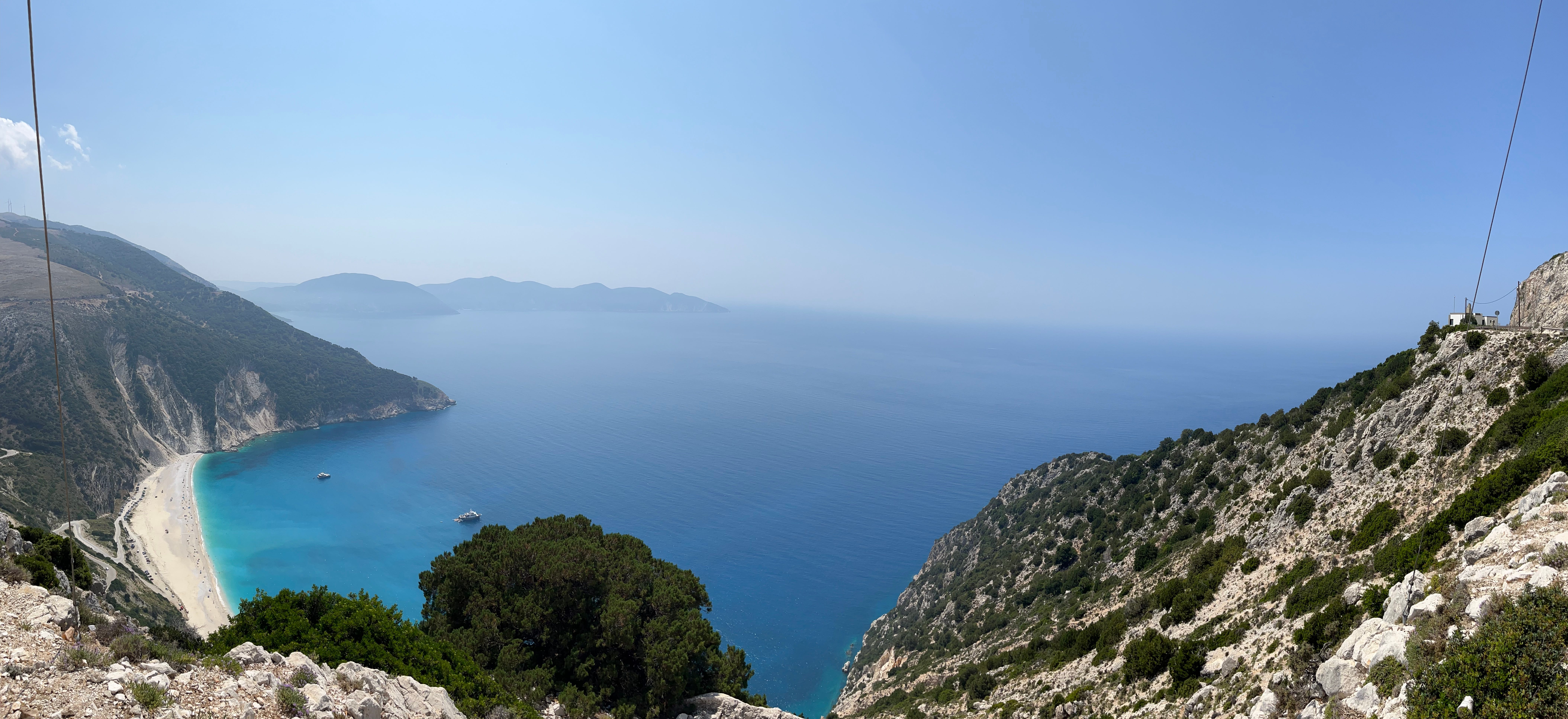
That would solve the location, but not the number of islands, or the elevation (the Cephalonian mainland is ruggedly mountainous, to say the least). Then Bittlestone had an idea: what if the western peninsula of Cephalonia had once been a separate island?
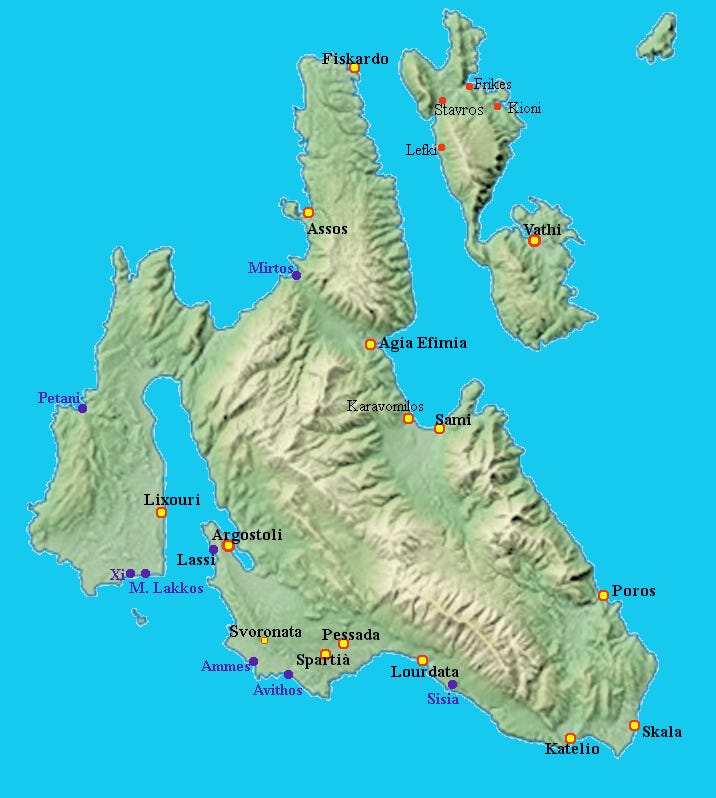
If this were to be the case – and a team of expert geologists are engaged at this very moment in trying to test if it is by working out whether the peninsula Bittlestone identified might once have been cut off by sea – then the island where Penelope was once said to have waited in a palace, weaving and unweaving her web for twenty years, while her husband made his voyage home, might actually be found.
And, to me, that’s a spine-tingling possibility. While Homer and Hollywood might make for a good tale, I think it’s the hunt for the real places and the people behind them that make for the best stories of all.
Because they’re the ones that are true.
Penelope’s Bones: A New History of Homer’s World through the Women Written Out of It is by Emily Hauser and has just been released in the US this week! You can get your own copy here:
It was a total joy to meet you and your family, Aristotle, Emily & all of the amazing co-conspirators looking for Homer. Thank you so much for setting it all up!
More often than not, the ancient texts themselves reveal how to read them appropriately. Ithaka is known to be a real place (like Troy), but concerning the adventures in the middle between start and end point of the Odyssean journey, the locations are ...... to be deciphered.
The cipher is given in the talks of Odysseus when he arrives in Ithaka. Because here, Odysseus is telling lies about his alleged journey, but the lies are realistic, while the "real" stories are fantastic - and both realistic lies and fantastic "real" stories are pointing to each other. Quite an ingenious literary construction, and this in the very first piece of Greek literature.