

Why Zeus Cared About Good Manners
The Rule That Shaped the Odyssey

Dear Classical Wisdom Reader,
Most of us like to think we’re good hosts.
We offer friends a drink when they come over. We make up the spare bed. We apologise if dinner is a little overcooked. We tell guests to make themselves at home.
The ancient Greeks would have approved...but probably not for the reasons you imagine.
For Homer, hospitality wasn’t simply about being polite. And it wasn’t good just etiquette or social convention. It was a sacred duty, watched over by Zeus himself.
Get it right, and you might earn lifelong friendships, powerful allies, or divine favour. Get it wrong, and kingdoms could fall, wars could begin, and heroes could die.
So yeah, it mattered!
Now, that may sound like an extraordinary amount to place upon offering someone dinner. Yet once you realise it, hospitality is everywhere in the Odyssey. It quietly shapes almost every major encounter, determines who is noble and who is monstrous, and even explains why Odysseus spends ten years struggling to return home.
You could say the whole epic begins and ends with Xenia…
I know lots of folks tend to remember the Cyclops, the Sirens, and the Trojan Horse... but Homer wanted us to notice something else as well… the way we welcome the stranger standing at our door.
Read on to understand this fundamental aspect to the epic that continues to inspire.
All the best,
Anya Leonard
Founder and Director
Classical Wisdom
The Odyssey: Be Our Guest with Xenia
By Ben Potter
If your mother taught you say ‘please’ and ‘thank you’, to not sit down until offered a chair, to bend over backwards to make guests feel welcome, and to always wipe your feet before before going in, then she might have picked up on the theme of xenia (hospitality) in The Odyssey.
However, it is unlikely she enforced it for the same reasons as the Homeric Greeks.
They were worried that they might have been talking to a powerful god in disguise and should, therefore, show good manners.
There are many rich and varied themes in The Odyssey: blood, guts and gore, tall-tales, deceptions and subterfuge, sex, glory, gold, family, love and gods. However, it may be surprising that above all these, it is one that appears so simple, xenia, that has a hugely dominant role to play.
However, we’re getting ahead of ourselves, what exactly was xenia?
Xenia has been broadly interpreted as comprising aspects of hospitality and generosity directed towards foreigners (i.e. those not from your town).
However, it was more than merely a set of manners and social customs, but actually a religious ritual which placed demands both on hosts and guests.
The god Zeus Xenios oversaw appropriate observation of the xenia laws. Slightly confusingly, Zeus Xenios is merely an aspect of the head god Zeus, and not a entirely separate being.
A good executor of xenia should:
Welcome strangers into the home
Offer them food, drink, and a bath
Give up the most comfortable chair for them
Not ask them any questions until they are satisfied and comfortable
Give them a gift to depart with
(When a guest) be respectful, charming, entertaining, don’t outstay your welcome and give a gift if you have one
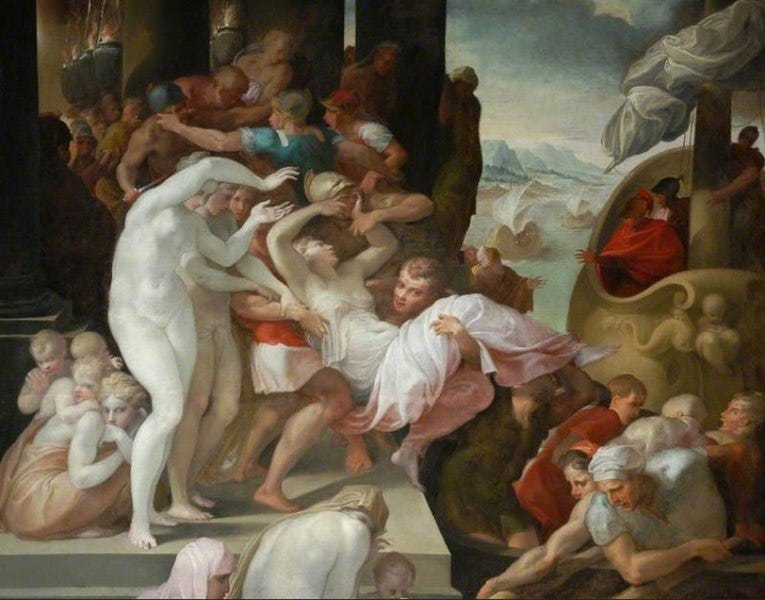
Xenia was actually the root cause of all the troubling situations Odysseus found himself in throughout The Odyssey. This is because the casus belli of the Trojan war, Paris’ abduction of Helen, was a most serious breach of xenia etiquette.
Whilst The Iliad, with its tensions and tantrums of the Greek commanders during the tenth year of the Trojan War, was predicated on a breach of hospitality, The Odyssey deals with it at every turn.
In fact the entire poem, chronicling the plight of a man trying to combat gods and monsters on his way home, is largely preoccupied with entertaining, or being entertained.
So much so that xenia underpins most of the significant scenes.
The moral/heroic quality of the majority of characters is determined (or reflected) by their adherence to, or rejection of, the conventions of xenia.
As early as book 1 we see that Odysseus’ wife, Penelope and son, Telemachus are obliged to entertain the 108 Suitors who are looking to usurp Odysseus. As Telemachus puts it, they are “eating up my substance, waste it away; and soon they will break myself to pieces” [1.251-252].
Such is the importance of xenia that, by honouring it, Telemachus would rather risk ruin and murder from the Suitors than wrath or disfavour from Zeus.
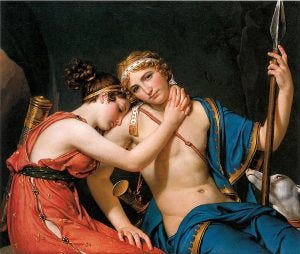
It is this quality of the often weak and emasculated Telemachus that shows his nature is truly heroic. e.g. Upon seeing a stranger in his house he “went straight to the forecourt, the heart within him scandalized that a guest should still be standing at the doors” [1.119-120].
He is held up in direct contrast to the blasphemous Suitors who are not only eating him out of house and home, but also show disrespect to the disguised Odysseus by throwing an animal hoof and a stool at him when he comes begging for food.
In books 1-4, Telemachus develops the xenia theme further by visiting the courts of Menelaus and Nestor. Here we have the chance to see how xenia should be properly conducted by wise and noble Homeric heroes.
The exception to this being Menelaus‘ wanton wife Helen, who refuses to accept personal responsibility for her xenia-breaching collusion with Paris: “I grieved for the madness that Aphrodite bestowed” [4.261-262].
Additionally, she commits the great sin of drugging Telemachus’ wine!
Our hero himself, Odysseus, is not exempt from incurring the wrath that goes hand in hand with disrespecting the laws of hospitality.
A key reason Odysseus’ journey home takes ten long years is because he angers the god Poseidon by blinding his son, the Cyclops. In itself, the act may be justified, but because it is done in the Cyclops’ home (well…cave anyway), Odysseus is breaking the xenia laws. He is being the ultimate bad guest.
In fact, Odysseus is doubly culpable in this case as, in addition to blinding his ‘host’, he also has the temerity to steal his cheese!
Likewise, Odysseus shows very poor hospitality by slaughtering the 108 suitors in his own house. He also brandishes a sword on the nymph Circe when he and his men pay a visit to her island.
These xenia transgressions of Odysseus are only forgivable because, even though he is sinning as both host and guest, he is sinned against even more gravely.
The poem’s ultimate retribution for transgressing xenia comes in a moment of bloody climax at the court of Odysseus.
Having been beaten and abused by the Suitors, Odysseus picks up and manages to string a mighty bow. A bow so large and cumbersome that nobody but the hero himself could manage to wield it.
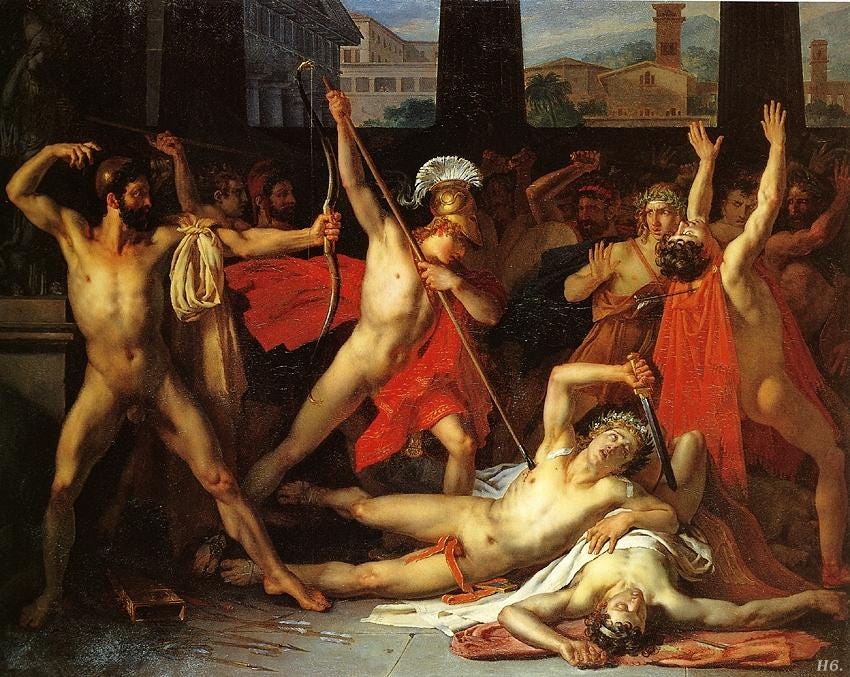
He takes aim and fires straight through the neck of the chief Suitor, Antinous.
The giant, almost inoperable bow had, aptly, been a xenia gift to Odysseus from Iphitos.
107 more Suitors fall to sword, spear and bow.
Thus blood pays for the dishonouring of host and household. The almighty Zeus finds a way to punish those who fail to show appropriate levels of honour and humility.
The hubristic and impious are slain without mercy.
Justice is done.
Xenia has won.
So next time, remember to wipe your feet.
This understanding of Zeus as the protector of hospitality and 'good manners' reveals how the ancients understood something profound that our modern, hyper-individualized world has completely lost. For the Greeks, hospitality (xenia) wasn't just superficial etiquette; it was the sacred, unwritten law that held the fabric of civilization together—an early recognition of what Stifter called the sanfte Gesetz, the gentle law that binds humanity through small, daily acts of mutual care. When we reduce interactions to mere transactions or view strangers purely as liabilities or networking opportunities, we sever that vital connection. Zeus cared about manners because how you treat a stranger at your door isn't just a matter of politeness; it is the ultimate test of your character and a reflection of your fundamental reverence for the shared fragility of human existence
This is echoed in the Judeo-Christian tradition where you might be entertaining Angels. Additionally you are enjoined not to “glean” to the edge of your fields so others may benefit from that