

The Spartan Mirage
Was it REALLY A Warrior State?

Dear Classical Wisdom Reader,
It’s a bit geeky, but…
There’s just something so cool about hearing Herodotus quoted in an action film.
In the movie 300, one of the MANY retellings of the Battle of Thermopylae, a Persian messenger dramatically tells the Spartans, ‘Our arrows will blot out the sun’.
The Spartan response, straight from the Histories, is presented like an Arnie one-liner: ‘Then we will fight in the shade.’
It’s definitely a cool moment… but is there more to it than that?
After all, 300 and movies like it, are part of a broader tradition of Sparta being portrayed on-screen as an incredibly war-like city state.
Of course, as we know, Hollywood has a history of taking liberties when it comes to, well, history… but even when it comes to looking at ancient texts, Sparta remain elusive.
The Spartans themselves never wrote anything down, so everything we know about them is filtered through the eyes of various ancient historians… who each, inevitably, had their own perspectives and biases.
So, how can we come to know the real Sparta? Was it really as ultra-militarised as the movies make it seem?
And is it possible the modern world has gotten Sparta wrong?
Read on below to discover what happens to warriors after the wars, and what’s really behind the Spartan mirage…
All the best,
Sean Kelly
Managing Editor
Classical Wisdom
The Spartan Mirage
Written by Meghan McKenna
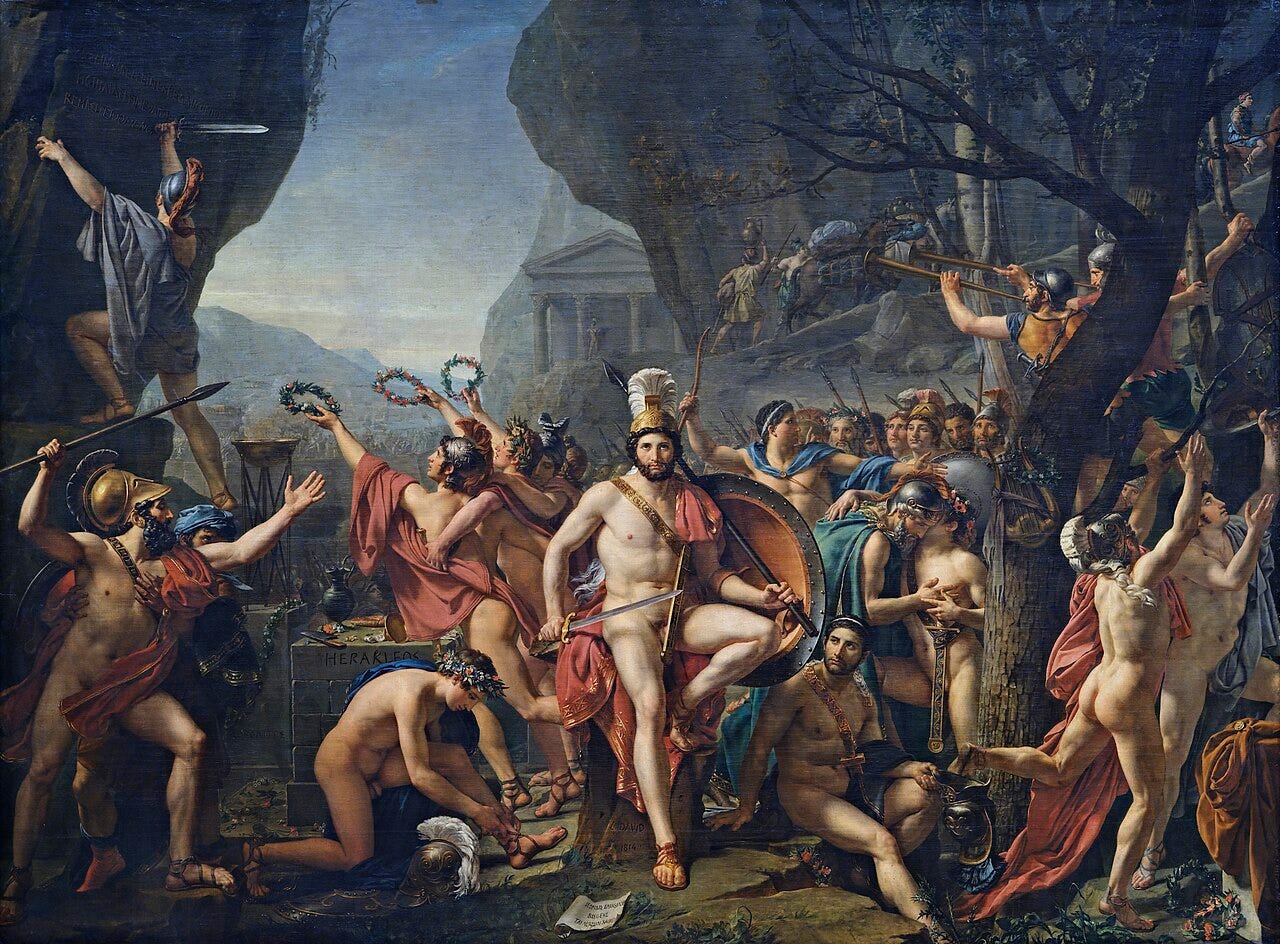
Sparta, home of ancient Greece’s most brutal warriors, trained their youths from childhood to become extremely capable soldiers; this is an image that has become a staple of popular thinking about Spartan society.
But is this really the case, or is this a force-fed misconception due to centuries of misrepresentation? Was Spartan society really as militarized as it is portrayed?
The first person to consider this and put it into writing was French Classicist François Ollier in the 1930s. He discussed how certain philosophers may have set a precedent of a militaristic Sparta which continued to color opinion through the centuries.
Xenophon, for instance, preferred the Spartan way of life and lived in Sparta for many years. Often, his praise of Spartan life is used to support the idea of Sparta as a heavily militaristic society, and his decision to live there gives credibility to this.
However, not all of Xenophon’s’ writing is considered when creating a picture of a militarised Sparta. In the Constitution of the Lacedaemonians, Xenophon writes an in-depth analysis of Spartan society, with the first thirteen chapters showing him praising the way Spartans raise their children, Spartan egalitarianism, and their warrior mindset.
In his final chapters, however, Xenophon flips his view, explaining that everything that had made Sparta a great city-state was disappearing, as the state became corrupt and no longer followed the laws set by Lycurgus. He further discusses how there was a decrease in morals and prestige, which made other city-states suspicious and cautious of Sparta gaining more power and taking control of Greece.
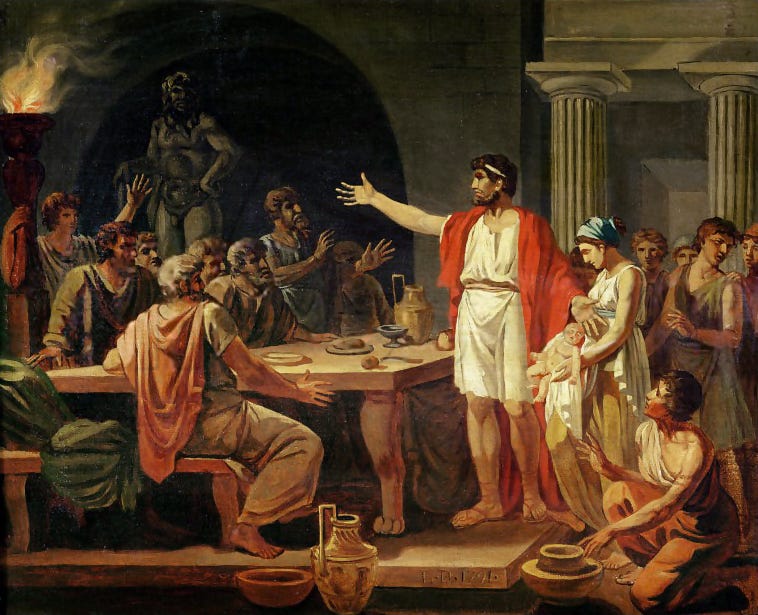
Plutarch also contributes to what Ollier called ‘the Spartan mirage’, as he writes based on the oral history of Sparta 500 years after its prime. Yet it was Plutarch’s writings that contained the famous story of Spartan mothers sending their sons off to battle with the phrase: ‘Come back with your shield or on it.’
Historian Philip Davies suggests that Plutarch’s writings are idealized, and states that even though Plutarch may have visited Sparta, it wouldn’t have resembled classical Sparta, as it had become “a tourist attraction which made a superficial claim to continuity with its glorious forebear.”
The way in which these classical writers contributed to the Spartan mirage is the most important explanation of how the image of a Spartan warrior-state has become so widely accepted, not only in our own society (with movies such as 300) but also in other societies, due to a snowball effect that began in ancient Greece itself.
Agōgē
The agōgē is a unique part of Spartan society and was believed to be an education system. Boys would start at the age of seven, teaching them obedience and endurance. Xenophon explains that the staff, known as Mastigophoroi, would carry whips and the boys would wear the same shoes and clothes all year round. They would be forced to train on little food, to encourage year-round endurance of the elements and the ability to continue when no food is available.
Many people would take this and instantly connect it to war. However, there is very little in Xenophon’s writing which actually points towards it being a military institution. French historian Jean Ducat suggests that the agōgē may be overemphasized by historians due to its sensational nature and the fact that there is nothing similar to it in other poleis.
Ducat also argued that it is likely that boys had a normal upbringing with private tutors. However, this is not focused on by the ancient writers, as the agōgē is “the most sensational part, certainly … but not necessarily the most important.”
Warriors, but not a Warrior-State
If we consider Sparta in comparison to other city-states or countries at the time, its military isn’t very impressive in size. In terms of size, Athens’ military consisted of hoplites totalling 13,000 and its fleet consisted of 300 ships, while landlocked Sparta had no navy and approximately half as many hoplites.
From this perspective, Sparta’s army was not the most impressive. It certainly goes against the portrayal of Sparta as a highly militarized society to find that they had such a small army and lacked naval warfare capabilities.
Moreover, if we look at the Persian army led by Xerxes, Herodotus describes the army as being made up of over two million fighting men. This is, of course, a hugely overestimated figure, and historians such as Andrew Robert Burn suggest that, with the amount of water supply available, the land around Thermopylae could support an army of at least 200,000 men led by Xerxes. But from what Herodotus says we can infer that no matter the actual figure of the army, it vastly outnumbered any Greek army, especially the Spartans.
Social Structure
Sparta was run with an oligarchical government who had put in place a rigidly hierarchical societal system, which depended on the smooth operation of various state functions and infrastructure. Spartan society would have likely had a plethora of administrative positions entrusted solely to Spartiates, meaning there would have been plenty of non-military jobs and responsibilities available, suggesting that there was more to Sparta than her military.
Although all men were expected to be a part of the military, at the age of thirty adult men were no longer active members. Moreover, many of them would have been injured in wars and no longer have been able to conduct military service. Are we to think that these men did nothing during their time away from the military?
Well, we would be wrong…
All families in Sparta had a kleros, an estate that financially supported their family financially, with helots working the land. Managing the kleros and the accounts were the man’s responsibility. The household would receive barley from the government each year, and the man was expected to pay syssitia fees.
There was a system in place to receive and acknowledge these payments, which employed Spartiate men who were either too old to campaign or injured. Once again, we see that there were roles in Spartan society that were non-militarized.
So while there is no doubt that a large part of Spartan society was dedicated to military service and training, there is evidence to show that it was certainly not their only focus.
With that in mind, perhaps it is time for us to rethink the way we portray this ancient city-state… but that doesn’t mean I won’t be watching 300 anymore.
If you scratch deep enough, history doesn’t collapse into lies - it collapses into narratives.
The difference between history and mythology is often not truth, but institutional survival.
What we inherit isn’t the past itself, but the stories that were allowed to remain.
The idea that Sparta was highly specialized elite infantry certainly rings true to me. If that holds up (and from my admittedly limited knowledge, it does), that feels like the real core of the Spartan story I’ve been fascinated by since 7th grade history. It’s a big part of what later drew me toward special operations, not because that’s what the whole military is, but because of the difficulty and discipline involved.
That said, I appreciate this reframing, and I’d love to see more direct sources on the agōgē argument, as well as learn more about the author’s background and training. Thanks for the post!