

The Sirens' Song
Can You Resist?

Dear Classical Wisdom Reader,
First things first: Happy New Year!
Yet as we get ready to dive into 2026, maybe we should check the waters first...
After all, you never know what dangers lurk at sea: so today we’re looking at some of the most compelling and enduring figures of mythology, the mysterious sirens.
Appearing across ancient literature, these hybrid beings stand as embodiments of the dangerous, treacherous nature of the sea, drawing sailors to their doom with their seductive song.
Yet there is a way to avoid this fate, as any reader of the Odyssey knows.
So read on below to discover what the rich, powerful, and evolving metaphor of the sirens can tell us about humanity and our past…
Of course, amongst other things, the sirens are symbols of temptation.
And, well, with many of us starting resolutions for the new year, here’s hoping, like Odysseus, we find a way to sail past the sirens to a better tomorrow for 2026!
All the best,
Sean Kelly
Managing Editor
Classical Wisdom
The Song of the Sirens
By Jocelyn Hitchcock
“For with their high clear song, the Sirens bewitch him, as they sit there in a meadow piled high with the moldering skeletons of men, whose withered skin still hangs upon their bones.” Odyssey. 12: 39-54
The elusive Sirens of the Aegean have been cornerstone characters in Greek mythology since the 7th century BCE. Having prominent scenes in the Odyssey and the Argonautika, and being heavily featured in vase paintings in the Aegean, Italy, and Sicily, the Sirens are well-known to us today.
Beautiful singing, captivating, fatal women of the sea permeate even children’s material, like The Little Mermaid… but, these half bird, half woman creatures are more complex than we may think at first glance.
The Origin of Sirens
Like most mythical creatures, the origin of the Sirens is unknown. Their parentage may come out of Gaia, Phorcys, Achelous, Sterope, and/or one of the Muses. Their concept in mythical terms is thought to be of eastern origin, brought over to Greece during the Orientalizing period when artistic motifs, themes, and ideas were adopted from Syria and Assyria.
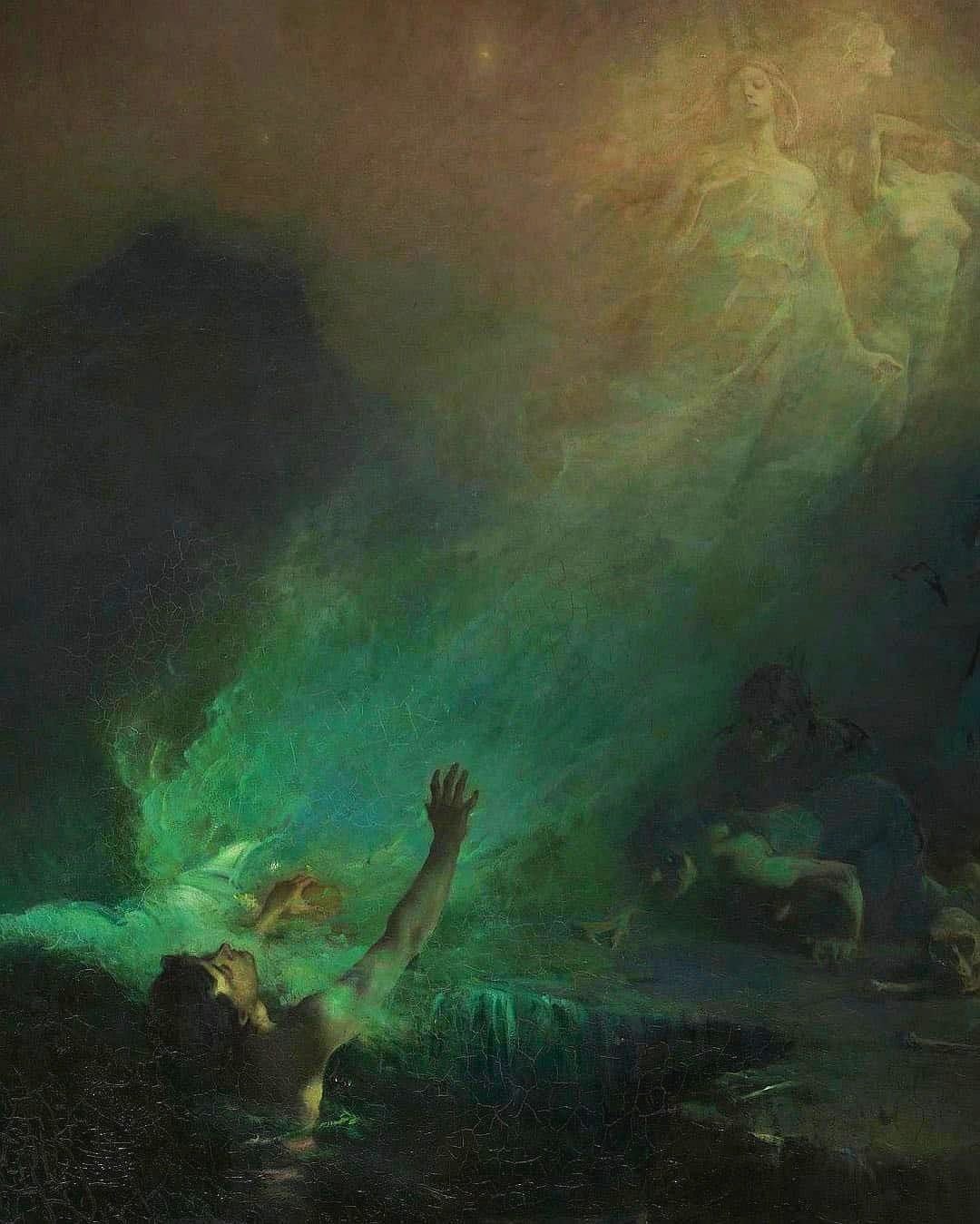
Some scholars have referred to the Sirens as ‘Soul-Birds” while others have considered them “other worldly enchantresses.” These soul-birds, an idea put forth by Georg Weicker, were essentially representations of the souls of the dead, who resided in the underworld. The Sirens then, acted as tests to seafarers traveling the dangerous straits, failure of which resulted in death.
The Form of Sirens
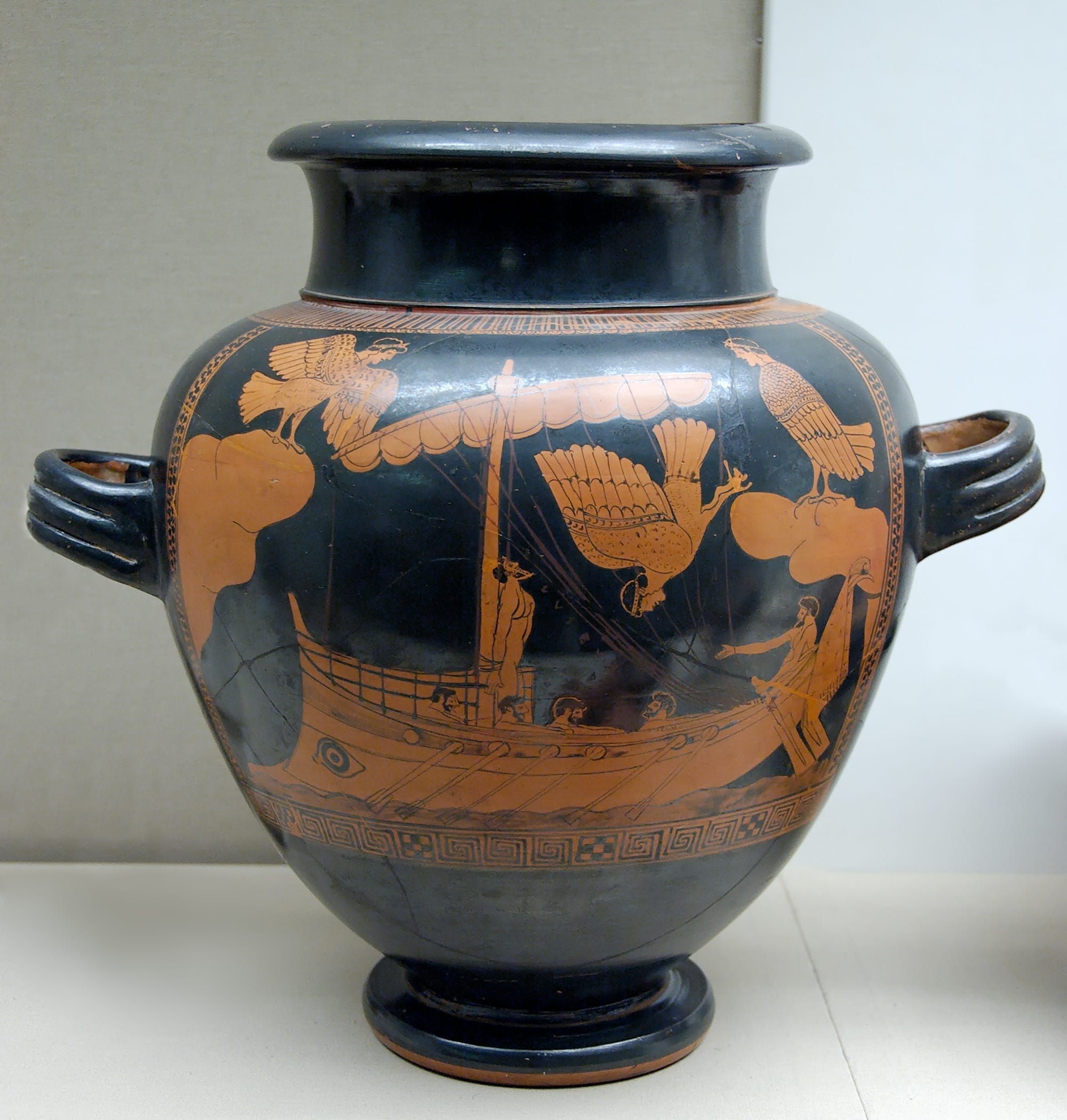
The form of the Sirens, in both literature and art, is relatively consistent: the body of a bird, the head of a woman and sometimes with human arms. The picture painted here is not one of a beautiful, seducing figure, but one of a grotesque, terrifying monster that does everything she can to lure men to their death.
So, like many mythical creatures and legends, are the Sirens a way for people to cope with the unexplainable difficulty plaguing this passage of sea? It certainly seems that way.
Odysseus and the Sirens
Perhaps one of the most poignant representations we have of the Sirens comes from Book XII of the Odyssey. The episode is split up between Circe’s foretelling of the event and Odysseus and his men’s actual experience. On their wanderings home, Odysseus and his men arrive at the Sirens’ island which is accompanied by an eerie calm. The crew plugs their ears with wax, Odysseus is tied to the mast, and they row closer to the island. When Odysseus asks to be set free, so he can succumb to the Sirens’ song, the crew ties him tighter so he can resist. They are able to pass, enduring the Sirens’ call and continue their journey.
It’s a short episode, but one that offers a great revelation into the Sirens. It shows who the Sirens were, what they did to entice sailors, and how ‘heroes’ can pass such a test.
Representations of Sirens
The Sirens were a common motif in vase painting, especially in Sicily and Italy. The combination of mythical creatures and Homeric themes was popular and desirable.
One vase, however, stands out amongst the rest. The so-called “Siren Vase” depicts the very scene in the Odyssey where Odysseus is tied to the mast, the men’s ears are filled with wax, and the Sirens are trying to entice them to their demise. It dates to 480-470 BCE and was produced in Attica.
Sirens: From Sea to Prostitute
The representation over time of the Sirens changed dramatically. Indeed, in the very beginning Sirens were shown to be male or female, but the male Siren disappeared from art around fifth century BC. Eventually the grotesque image of the Siren evolved to where their form was as beautiful of their song.
With this dramatic change, so too did their symbolism transform. No longer a metaphor for the sea, the Siren became the tempting seductress.
The Early Christian euhemerist interpretation found in Isidore’s Etymologiae (circa 600) described them as such:
They [the Greeks] imagine that “there were three Sirens, part virgins, part birds,” with wings and claws. “One of them sang, another played the flute, the third the lyre. They drew sailors, decoyed by song, to shipwreck. According to the truth, however, they were prostitutes who led travelers down to poverty and were said to impose shipwreck on them.” They had wings and claws because Love flies and wounds. They are said to have stayed in the waves because a wave created Venus.
It is this final image of the Siren that has preserved so thoroughly in art and cultural references. Just what our modern reinterpretation of this once terrifying mythological monster says about us, and the modern world we navigate, is for the reader to decide.
Sadly you have mistaken the Sirens’ appearance and wrongly given the passage describing Scylla who lives in the cliff cave above Charybdis the whirlpool.
Apollodorus writes “The Sirens were daughters of Acheloos by Melpomene, one of the Muses, and their names were Peisinoe, Aglaope, and Thelxiepeia. One of them played the lyre, another sang, and the third played the flute, and by these means they caused passing sailors to want to remain with them.” To imply that because the mother of the sirens is the muse of tragedy, then by “blood guilt” so are the sirens is a little strong. Counter example, Debussy’s Nocturnes.