

The God Everyone Feels
Blowin' in the Wind?

Dear Classical Wisdom Reader,
How quickly the winds change…
Not so long ago, I was writing to you about the seemingly inescapable god of the sun, Helios.
All of a sudden, Helios is much harder to find! And as the seasons change, in his place, a different god is reigning supreme: Aeolus, keeper of the winds.
Nowadays, Aeolus is perhaps best known for his appearance in the Odyssey. Yet the other tales surrounding him present a perplexing figure: is he a human king or a god? Was he actually the ancestor of the Hellenic people?
And is his mysterious island home a real place?
Read on to discover how, like a wise man once said, the answer is blowin’ in the wind…
All the best,
Sean Kelly
Managing Editor
Classical Wisdom
Aeolus: Keeper of the Winds
by Jocelyn Hitchcock
In Greek mythology the name Aeolus pops up in reference to three different characters: Aeolus, the son of Hippotes, and keeper of the winds; Aeolus, the half-human son of Poseidon; and Aeolus, the son of Hellen (not the Helen of the Trojan War, but a mortal ruler who is the legendary ancestor of the “Hellenic” people).
While the Aeolus of the Odyssey is clearly identified as the keeper of the winds, later Roman writers such as Ovid conflate the various Aeolus’ together. It’s all very confusing, but it wouldn’t be Greek mythology if it weren’t!
Here we’re going to focus on the figure from the Odyssey, as he is the most prominent of the three.
Aeolus, or Aiolos, was said to reside on the floating island of Aiolia/Aeolia. In geographic terms, Aeolus is an area in the west and northwestern region of present day Turkey, along the coast, including the offshore islands. Instead of a specific island, the Aeolic region is one of shared cultural and linguistic traits. The island of Aeolia itself, where Aeolus was said to reside, has not been identified and itself is mythological.
Powers
The power of Aeolus rested in his control of the winds. Traditionally, Kronos or Zeus had made Aeolus ‘warden’ of the winds, so that he could order them to rise or fall or shift at his pleasure.
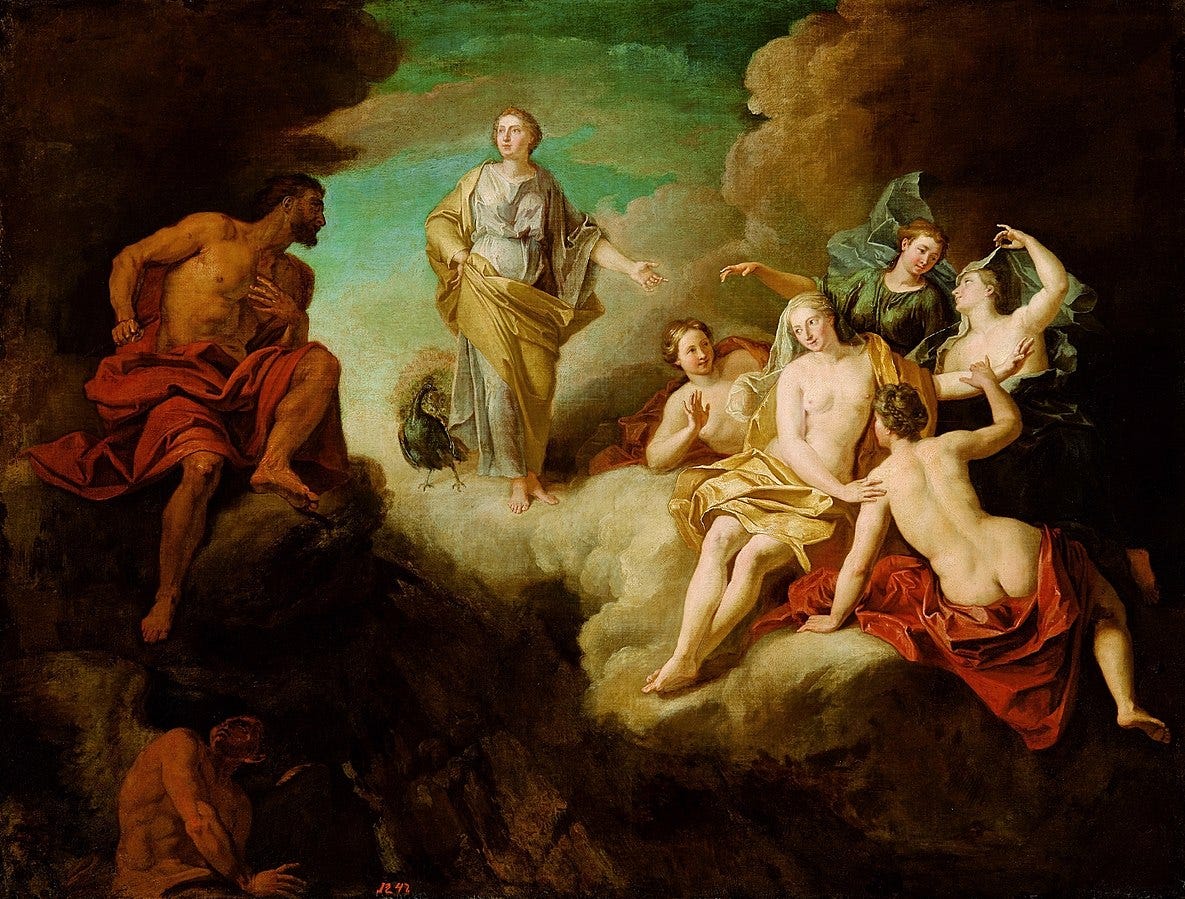
He kept the violent storm winds locked away inside a cavern on the island, only releasing them upon order of one of the greatest gods. For instance, in Virgil’s Aeneid, Aeolus unleashes the winds against Aeneas at the request of Juno, the queen of the gods, who promises Aeolus marriage to the nymph Deiopea in return.
Appearance in the Odyssey
In the Odyssey, Odysseus describes the island of Aeolia as “a floating one,” and with a “wall of bronze, unbreakable, and rock[s rising] sheer above it.” Odysseus claims that Aeolus has 12 children living in his palace, six daughters and six sons, all paired off to one another.
“Then to the Aeolian isle we came, where dwelt Aeolus, son of Hippotas, dear to the immortal gods, in a floating island, and all around it is a wall of unbreakable bronze, and the cliff runs up sheer.”
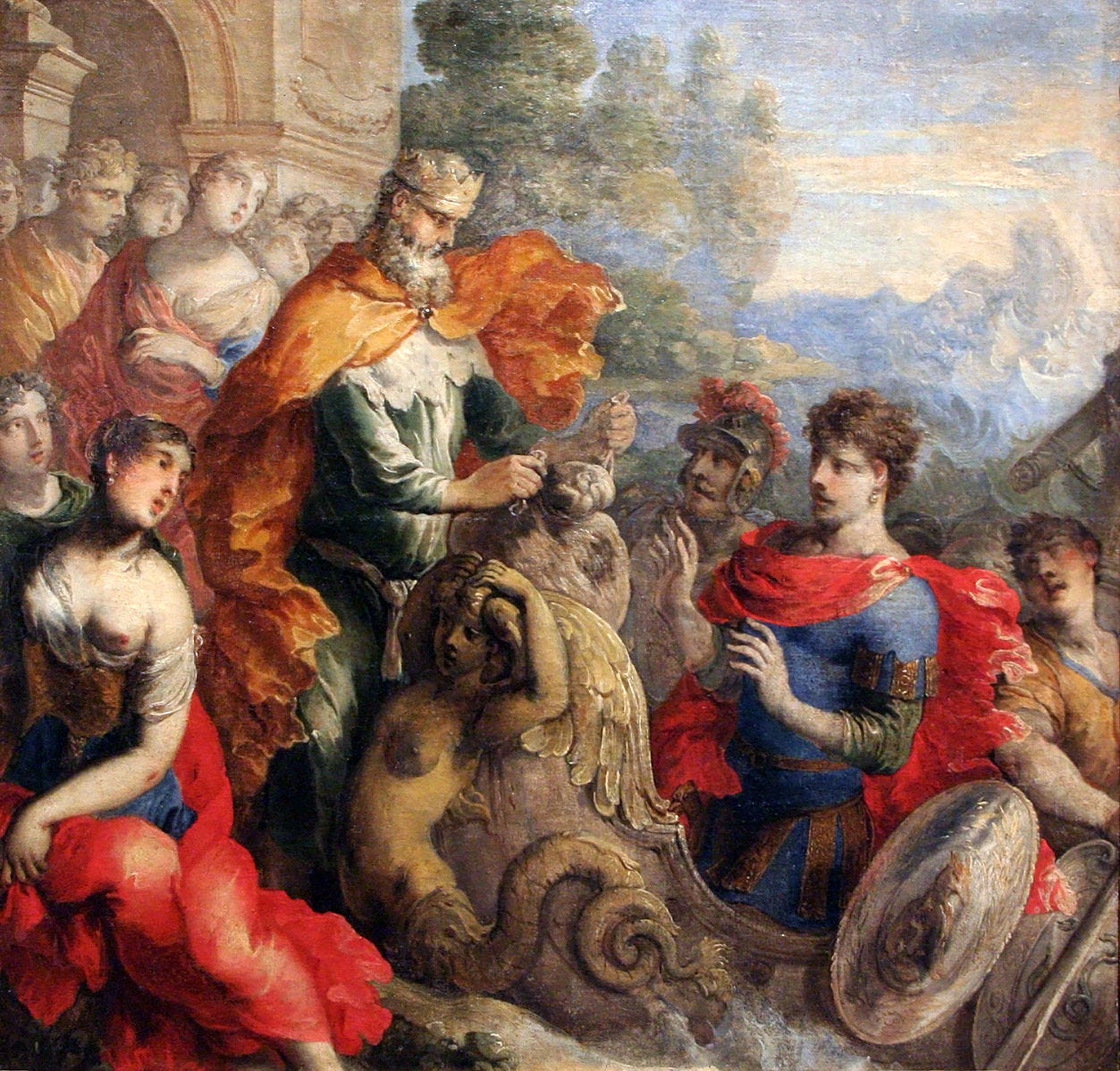
According to the epic, Aeolus welcomed Odysseus and his men for a month, offering hospitality and encouraging Odysseus to relay the story of Ilium and the Argives. When it was time for Odysseus and his men to begin on their way again, Odysseus asked for help from the keeper of the winds, with Aeolus granting Odysseus a bag made of ox hide, filled with every wind that blows, regardless of the direction.
To this, Aeolus placed the bag in Odysseus’ ship hold, “tied with a glittering silver cord,” and gave the westward wind instruction to blow alone, carrying Odysseus and his men home.
“But when I, on my part, asked him that I might depart and bade him send me on my way, he, too, denied me nothing, but furthered my sending. He gave me a wallet, made of the hide of an ox nine years old, which he flayed, and therein he bound the paths of the blustering winds; for the son of Cronos had made him keeper of the winds, both to still and to rouse whatever one he will. And in my hollow ship he bound it fast with a bright cord of silver, that not a breath might escape, were it never so slight. But for my furtherance he sent forth the breath of the West Wind to blow, that it might bear on their way both ships and men. Yet this he was not to bring to pass, for we were lost through our own folly.”
It wouldn’t be the Odyssey, though, if there wasn’t some snap in the plan. Odysseus himself claimed that it was their own “folly” that ruined them. According to the epic, the ship was in sight of their land on the 10th day sailing from Aeolus. They could see the fires of their shores.
However, the crew, positive that Odysseus was bringing home riches from Aeolus, opened the bag of winds to see for themselves. At this, the winds rushed out all at once and hurled the ship back to the open waters and to the shores of Aeolus once again.
When the keeper of the winds questioned Odysseus as to why they had returned, Odysseus admitted it was the result of his foolish crew. Aeolus said he was forsaken by the gods and banished him from the island, without any further help.
“`How hast thou come hither, Odysseus? What cruel god assailed thee? Surely we sent thee forth with kindly care, that thou mightest reach thy native land and thy home, and whatever place thou wouldest.’
“So said they [Aeolus with his wife and children], but I with a sorrowing heart spoke among them and said: `Bane did my evil comrades work me, and therewith sleep accursed; but bring ye healing, my friends, for with you is the power.’
“So I spoke and addressed them with gentle words, but they were silent. Then their father answered and said: `Begone from our island with speed, thou vilest of all that live. In no wise may I help or send upon his way that man who is hated of the blessed gods. Begone, for thou comest hither as one hated of the immortals.’”
There has been some confusion as to whether Aeolus was considered an actual god or a human being granted special supernatural authority. This is likely due to the patchwork nature of oral storytelling traditions which birthed the various myths, but the ancient Greek historian Diodorus Siculus offers an intriguing rationalization:
He was, they say, pious and just and kindly as well in his treatment of strangers; furthermore, he introduced sea-farers to the use of sails and had learned, by long observation of what the fire foretold, to predict with accuracy the local winds, this being the reason why the myth has referred to him as the "keeper of the winds"; and it was because of his very great piety that he was called a friend of the Gods.
Depictions
Artistic depictions of Aeolus were not very popular, perhaps due to the muddled nature of the three Aeolus’. Roman and Sicilian renderings of Aeolus show a male face with the lips blowing at the earth, a tree, the ocean, etc. More paintings and drawings of Aeolus became common during the Renaissance, but still they are not copious.
After all, the wind isn’t something you see, it’s something you feel. And no painting can capture the power of the god of the winds!
When the Sicels conquered Sicily (whence the name of the island) they conquered the Aeolian islands first. And their leader was Aeolus. Later, a certain Italus led the Sicels to the island of Sicily, at Messina. Both leaders, Aeolus and Italus, are thought of as sons of Poseidon. Maybe it was one and the same person. -- Now comes the crucial part: Poseidon is also an interpretatio Graeca of Adranus, the highest god of the Sicani, the more ancient inhabitants of Sicily. Later, Sicani and Sicels conflated their gods, made peace and divided the island among them. It is almost certain that behind the traditions of Poseidon being the ancestor of Aeolus and Italus is the god Adranus, and that being the son of Adranus is an integration into the existing legitimation system of culture, religion and power on the island.