

The Fury Within
Anger in Ancient Greek and Roman Mythology

Dear Classical Wisdom Reader,
It seems we’re living in an age of anger, or at least, an age where it’s impossible to ignore it. Outrage trends daily. The furious tweet, post, and protest with ease, and their fury can spark movements, division… or even change.
This raises an ancient question that still divides philosophers and psychologists alike: can anger ever be a force for good? Should it be unleashed or restrained, redirected, refined?
To explore this, we can turn to a surprising source: mythology.
The Greeks, as always, had a word, or rather, many words, for it: mēnis, thumos, orgē, kholos…each describing a different shade of anger, from divine wrath to mortal passion.
By looking at how figures like Ares, Athena, Medea, and Achilles embodied these emotions, we can uncover how the ancients understood anger…not as a single destructive force, but as something complex, even purposeful.
Perhaps, by learning from them, we can better recognize and master our own modern rages.
So, read on to discover how anger thundered through the myths of old—and why it might still have something to teach us today, especially following Friday’s deep dive into Achilles.
All the best,
Anya Leonard
Founder and Director
Classical Wisdom
The Fury Within: Anger in Ancient Greek and Roman Mythology
By Anya Leonard
“Rage - Goddess, sing the rage of Pelus’ son Achilles!” - The Iliad, translation by Fagles
Thus begins the first line of the most important, foundational work of the ancient Greek world. But while Homer’s great epic, the Iliad, is the beginning of the literary tradition for us, it is really the end of a much longer oral tradition for the ancients. It’s essentially the codification of generations of stories, illustrating that the concept of anger is really as old as civilization itself.
Clearly, it is one of the most powerful emotions we humans can experience. It can drive people to action, fuel a sense of justice, and can be a catalyzing agent for overcoming injustices as well as conquests. But it can also be all consuming, leading to destruction...both of the individual and the community.
The ancient Greeks and Romans understood this all too well. Their myths are filled with stories of anger—gods and mortals alike driven by wrath, vengeance, and wounded pride. These stories aren’t just entertaining—they offer deep insights into human nature and the consequences of unchecked rage. They are often mirrors into our own, universal psyches.
One of the great things about the ancients are their words, specifically their tendency for careful observation and nuanced terminology. As such, the Greeks didn’t see anger as a singular emotion. They recognized its complexity and gave it many names: mēnis, thumos, orgē, and kholos. Each of these words represents a different kind of fury, a different way in which wrath and rage manifests in gods and mortals alike. But what do these different faces of anger reveal about human nature, morality, and power?
Mēnis: The Divine Wrath That Shakes the World
Homer doesn’t begin his epic with a dinner party, some lovely garden settings or wedding... No. He hits us first and foremost with mēnis, or wrath. This is, of course, no accident. It immediately sets the stage for a story not just about war, but about anger... specifically, a wrath so great that it alters the fate of nations.
Mēnis is not mere frustration. It is godlike fury, cosmic and unstoppable. It is the kind of rage that belongs to Zeus when he punishes mortals with lightning, to Apollo when he strikes the Greeks with a devastating plague because Agamemnon insulted his priest.
And uniquely, it belongs to Achilles, a mortal touched by divine rage.
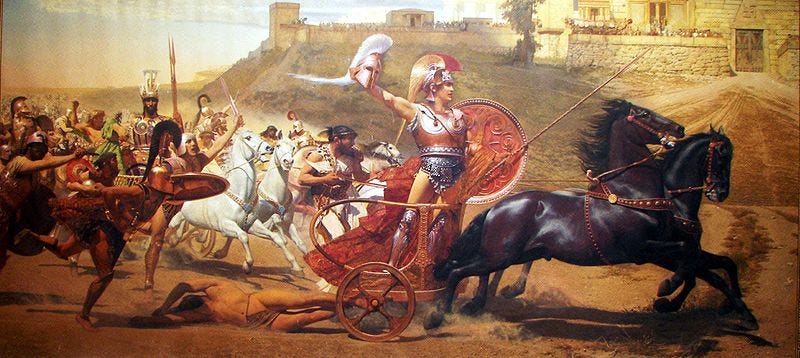
When Agamemnon, the so-called leader of the Greek army, takes Achilles’ war prize, the woman Briseis, Achilles does not simply protest. He withdraws from the war altogether. His rage is so consuming that it changes the very course of the conflict. He refuses to fight, allowing his own comrades to suffer, watching until his closest friend, Patroclus, is ultimately slain by Hector. Only then does Achilles return to battle, and when he does, his wrath is apocalyptic. He slaughters Hector, mutilates his corpse, and refuses to allow him a proper burial, an act that horrifies even the gods.
Mēnis is rage beyond reason. It is the kind of anger that does not listen to pleas, that turns men into something more and less than human. And yet, in Achilles, we also see its consequences. For all his power, he is not victorious. He is left empty, grieving, and doomed to die. His rage has shaped the war, but it has not saved him.
Thumos: The Warrior’s Fire
Where mēnis is divine and destructive, thumos is the fire in the heart, the anger that fuels warriors, the passion that drives men to act with courage and conviction. It is what makes Hector stand against Achilles, knowing he will die but refusing to surrender. It is what drives Odysseus to keep fighting, to outthink his enemies, to endure.
But thumos is also dangerous. It flares up quickly and can lead to ruin. Consider Heracles, perhaps the most thumos-driven hero of them all. His entire life is defined by anger and action—anger that fuels his strength, but also anger that brings about his greatest tragedy.
In one of the darkest moments of Greek mythology, Hera, always vengeful, sends madness upon Heracles, and in a blind rage, he murders his own wife and children. When he regains his senses, he is horrified... but the damage is done. His thumos, which made him a hero, has also made him a monster. To atone, he undertakes the famous Twelve Labors, enduring impossible tasks as penance. But no matter how many monsters he slays, he can never undo what he has done.
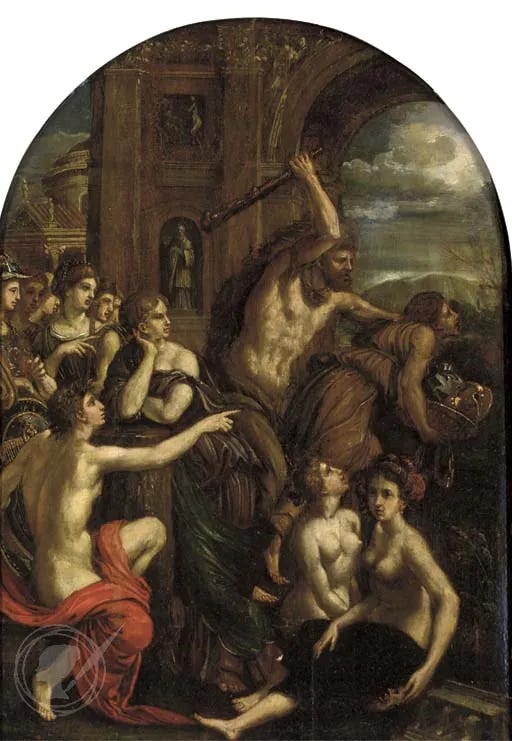
Thumos, then, is not simply heroic passion. It is a double-edged sword. It is what makes men great, but also what can lead them to destruction if not tempered by wisdom.
Orgē: The Long Memory of Anger
If mēnis is explosive and thumos is passionate, orgē is something different: slow-burning resentment, the anger that lingers, festers, and waits for vengeance. Orgē is the anger that does not forget; the grudge that lasts a lifetime.
One of course thinks of the queen of the gods, Hera.
Time and again, we see Hera’s ability to hold grudges far beyond the moment of offense. When Zeus fathers Heracles with the mortal woman Alcmene, Hera does not simply express her anger and move on. Instead, she wages a lifelong campaign of torment against Heracles. She sends snakes to his crib as an infant and monstrous enemies against him at every turn. Her rage does not explode...it persists, poisoning generations.
Poseidon, too, holds onto orgē. When Odysseus blinds his son, the Cyclops Polyphemus, Poseidon does not strike him down immediately. Instead, he ensures that Odysseus wanders for ten years, facing shipwrecks, storms, and horrors, before he can finally return home.
But perhaps the most haunting example of orgē is found in Medea.
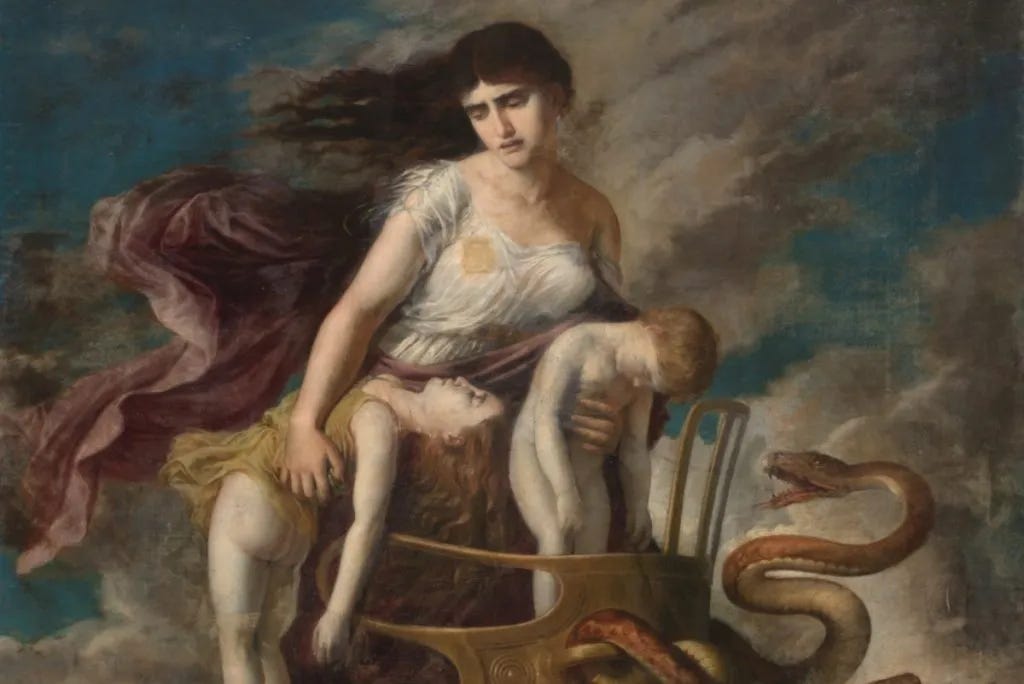
Medea is no mere woman scorned. She is a force of rage that waits, calculates, and strikes when the moment is right. When Jason, whom she sacrificed everything for, betrays her by marrying another woman, Medea does not lash out immediately. She does not scream or challenge him to a duel. Instead, she plots, waits, and unleashes a revenge so complete that it leaves Jason utterly broken.
She murders Jason’s new wife with a poisoned robe, burning her alive. But that is not enough. To ensure Jason suffers fully, she kills their own children, denying him any legacy, any future. It is an act so horrifying that it transcends personal vengeance; it is the embodiment of anger that has lost all boundaries, that no longer distinguishes between justice and destruction.
Medea’s rage is terrifying because it is not blind; it is cold, deliberate, and absolute. And yet, she is not a villain in the traditional sense. The audience of Euripides' time may not have approved of her actions, but they understood her pain. She had been wronged, discarded, humiliated and in her fury, she became something greater and more terrible than anyone imagined...
Medea forces us to ask: At what point does righteous anger become monstrous? When does the pursuit of justice turn into self-destruction?
(Also, as a side note, earlier traditions of Medea did not include such a level of destruction! That was a later invention by Euripides, so the audience would have been shocked by her treatment.)
The Fury: Beyond Orge
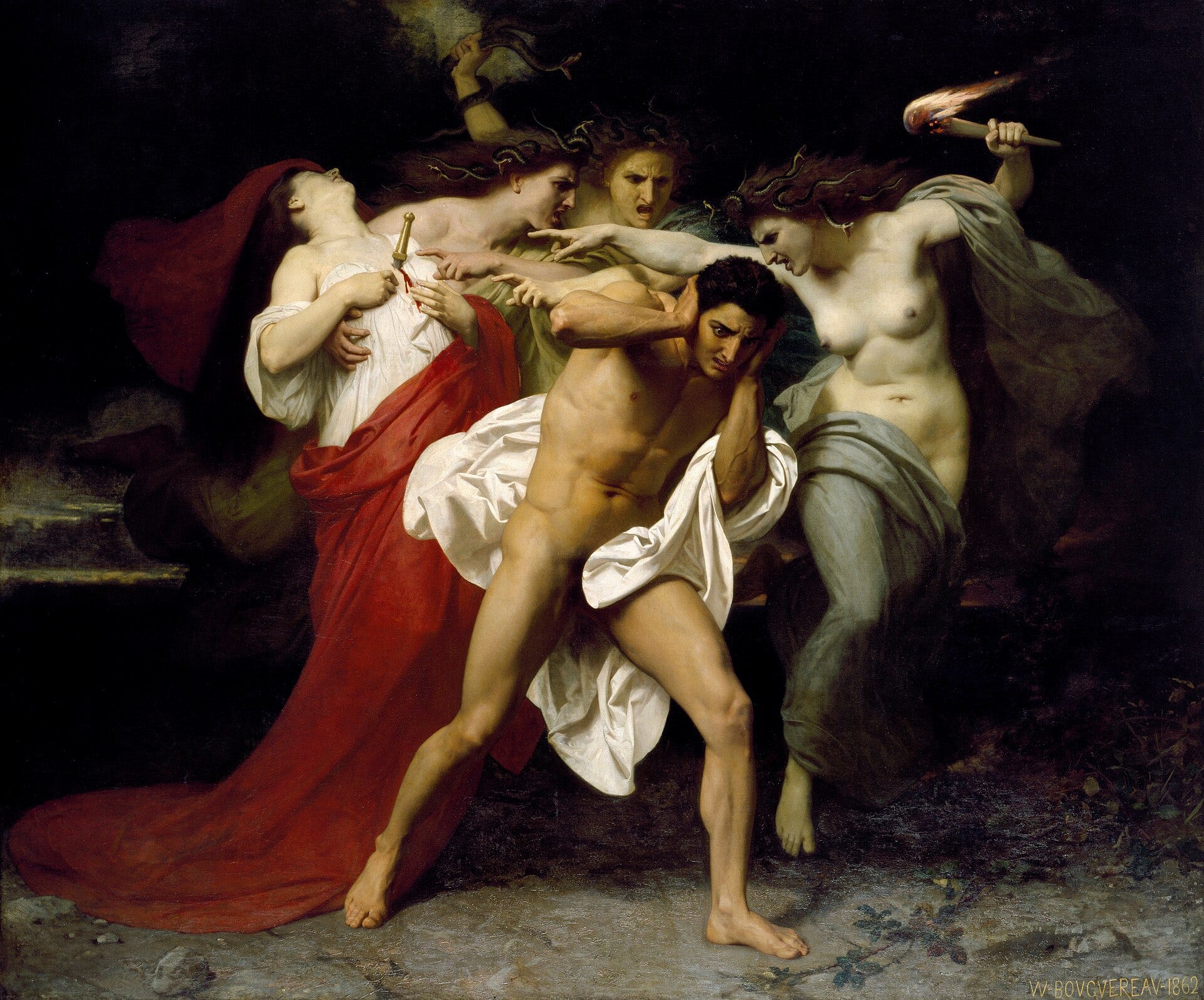
The most extreme form of orge is embodied by the Furies. They represent relentless, vengeful wrath, divine agents of justice driven by moral indignation. Their anger wasn’t just emotional; it was a cosmic force ensuring the guilty were punished.
When Orestes, the son of the Agamenom, killed his mother, Clytemnestra, to avenge his father, the Furies hunted him down, demanding retribution for matricide. Their wrath was unstoppable, only satisfied when justice was served. And this was not just by human laws but by a higher moral order.
Ultimately, the goddess Athena presided over Orestes' trial, introducing reasoned judgment as a counter to divine fury. (Though, for the record, I don’t agree with her verdict!) The Furies’ pursuit of Orestes shows orge as a destructive yet sacred force, one that only the logic of law could temper.
Kholos: The Short Fuse
Lastly, there is kholos, the most immediate and human form of anger, the quick, flaring temper that comes and goes. Unlike orgē, it does not last; unlike thumos, it does not drive action. It is a flash of temper, a momentary loss of control.
In a way, kholos is the most relatable of these forms of anger. We have all experienced it. We have all spoken words we regret in the heat of the moment. The Greeks understood that kholos, though dangerous, is also natural...what matters is how one controls it.
Zeus, for all his wisdom, is frequently ruled by kholos. He lashes out with thunderbolts, threatens gods and mortals alike, and yet often calms just as quickly. We see this when he argues with Hera, when he punishes mortals, when he becomes enraged by defiance, only to be pacified soon after.
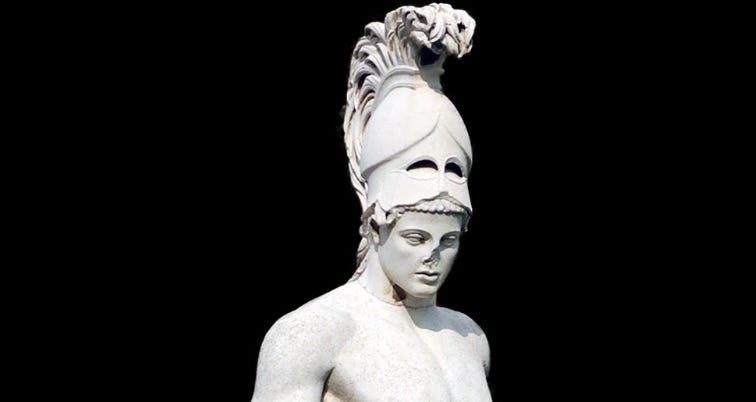
And of all Zeus’ children, perhaps none inherited this trait more than Ares, the god of war. His anger isn’t personal, it is instinctive. He embodies the chaos of battle, driven by rage rather than reason.... but his character serves as a warning: Anger without control leads to ruin, and brute force without wisdom is ultimately futile.
Strategic Anger: Athena
Now, in contrast to Ares, who is reckless, charging into battle without thought, his sister, the goddess Athena, approaches war with strategy and discipline. Athena is primarily known as the goddess of wisdom, strategy, and warfare, and her anger, when it occurs, tends to be more measured and strategic rather than impulsive or destructive and is often related to her sense of justice, honor, or defense of her principles. For instance, she might be angry when someone challenges her wisdom or violates a sacred oath or code of conduct...or she might assist a hero, such as Odysseus, in exacting revenge against those who have wronged him.
Either way, Athena's anger is generally more disciplined and tied to a sense of justice or strategic goals, rather than being driven by blind rage or impulsive fury.
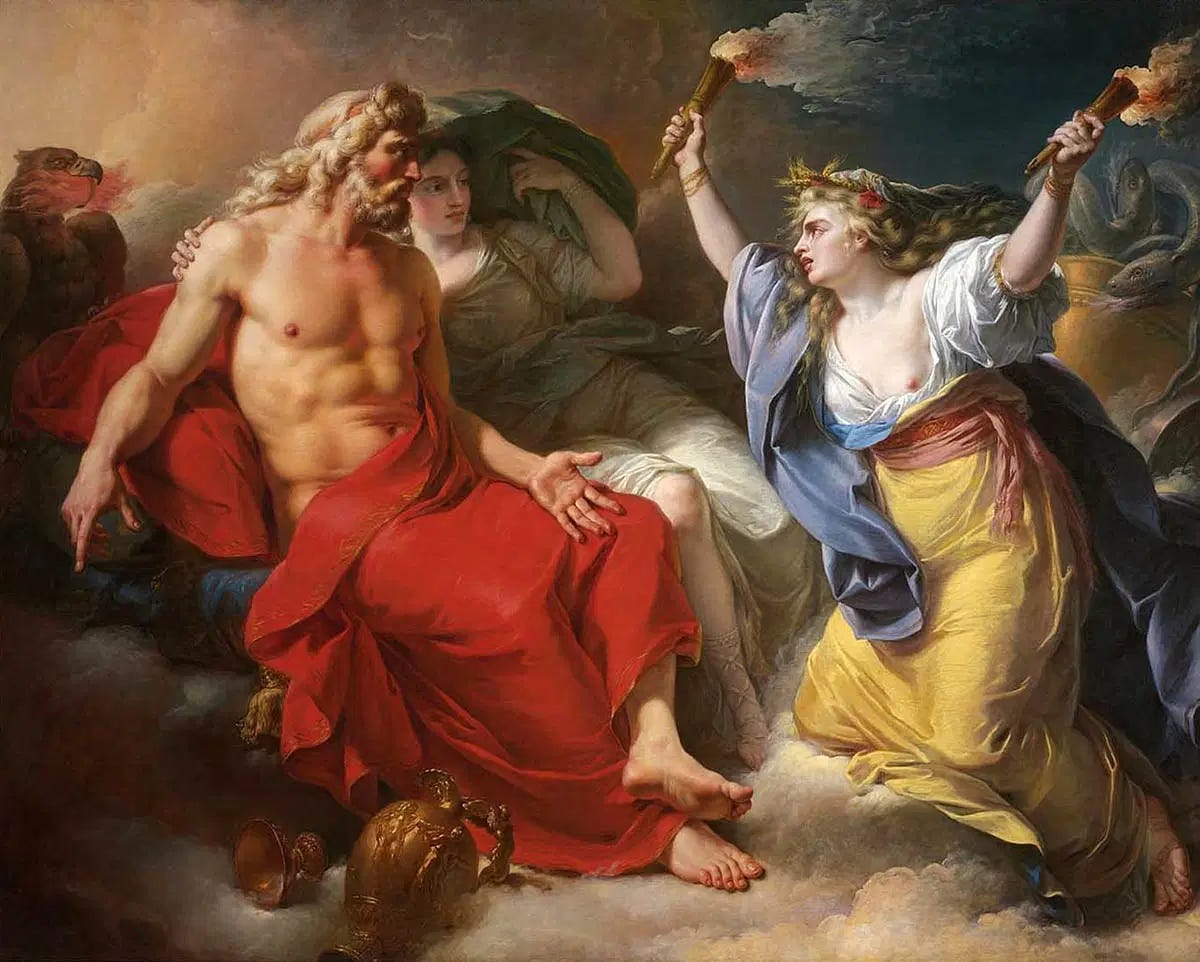
Similarly, Demeter’s anger in the Homeric Hymn to Demeter is a reaction to the abduction of her daughter, Persephone, by Hades. Instead of immediate violence, Demeter expresses her rage through a strategic act; she causes a famine until Zeus intervenes. Her anger is not uncontrolled but channeled into action that ultimately restores order.
What Can We Learn from the Anger of the Gods and Heroes?
The myths of Greece and Rome weren’t just meant to entertain; they were cautionary tales, reflections of human nature, warnings about the power of unchecked emotion.
Indeed, mythology has inspired philosophers and psychologists for time immemorial specifically because it mirrors deep fundamental human emotions and gives our fears, dreams and concerns shapes, stories and narratives in which we can make sense of them. Through these stories we can talk and understand primordial feelings, like anger, and teach our children and community what they mean.
So... after this very brief foray into Mythological anger, it’s essential to ask what do these stories teach us? What exactly are the takeaways? Of course the lovers of mythology and ancient Greek language can derive many lessons from these stories, depending on their perspective and disposition... but if I may, I will volunteer these four:
Uncontrolled anger leads to destruction. Achilles’ wrath cost him his dearest friend. Medea’s fury led to a tragedy she could never undo. Mythology shows us that when anger controls us, it can push us toward irreversible actions.
Holding onto anger is just as dangerous as expressing it. Hera never lets go of her resentment, and it consumed her actions for centuries. Carrying grudges doesn’t just harm others—it poisons us from within.
Anger can be a tool, but it must be tempered with wisdom. Athena, unlike Ares, used strategy rather than reckless aggression. Anger can drive us forward, fuel our sense of justice, and push us to make change—but only if we direct it wisely.
Revenge does not bring true satisfaction. Many of mythology’s greatest tragedies stem from the pursuit of vengeance. From Medea to Achilles, those who seek revenge often suffer just as much, if not more, than those they target.
Final Thought
Anger is a fundamental part of being human. It can be destructive, but it can also be a force for justice and change. The key is learning to control it, rather than letting it control us...something we see again and again in Greek mythology.
So the next time you feel anger rising, ask yourself:
Will you be Achilles, with menis and thumos charging forward? Hera embodying orgē, holding onto resentment for years? Or Athena, channeling your emotions into something greater?
The choice, as always, is yours.
Great post! I was familiar with 'thumos' but did not know the other forms of fury. With so many unique words, Greek has a fantastic capacity to open one's emotional spectrum.
There's such a need to return to classical sources in this changing era we're experiencing. The permanent foundations that give meaning to human dignity and reality are present there. Thanks for the post.