

Technological ‘Miracles’ Of Ancient Greece
Which Marvel Matters Most?

Dear Classical Wisdom Reader,
Through the magic of modern technology I’m currently writing to you from a flying contraption that is 11,200 meters in the sky going 80% the speed of sound. Outside the rounded windows are wispy clouds and the patchwork farms of Germany... or maybe Luxembourg… far below.
Of course I can’t claim credit for this miraculous achievement; they are well beyond my own humble tech abilities, which are... severely limited. Indeed, I’ve spent the last couple of transit hours manually processing all the book sales for our new Founding Members.
[On that note: If you recently took advantage of our Founding Fathers - Founding Members Offer and have not already heard from me - PLEASE CHECK YOUR INBOX AND SPAM/PROMOTIONS folders and then email me at info@classicalwisdom.com. We do not have your address on file and will be sending out the newly printed Essential Classics hardback books this week.]
And yet, despite my clear deficiencies, I’m somehow able to enjoy the benefits of thousands of years of technological development...the ‘miraculous’ results grown from the ideas and concepts that were once born in the ancient world.
So today, we will take a moment to appreciate some of the technological ‘miracles’ of the ancient world. Have a read below and let me know which one you think has had the biggest impact.
All the best,
Anya Leonard
Founder and Director
Classical Wisdom
Technological ‘Miracles’ Of Ancient Greece
By Arslan Hassan, Contributing Writer, Classical Wisdom
The ancient Greeks are rightly celebrated for their philosophical insights, literary achievements, and political innovations. Yet, less frequently acknowledged but equally remarkable is their mastery of science and technology. From automated machines and musical instruments to architectural marvels and hydraulic engineering, the technological ingenuity of ancient Greece laid the foundation for countless modern advancements.
Contributions to Entertainment and the Performing Arts
The Greek contribution to the arts extended well beyond dramatic storytelling. They revolutionized the very structure of entertainment by engineering the mechanics of theatrical production. It was in Greece that theater evolved from simple oral performances into an immersive, mechanically enhanced spectacle.
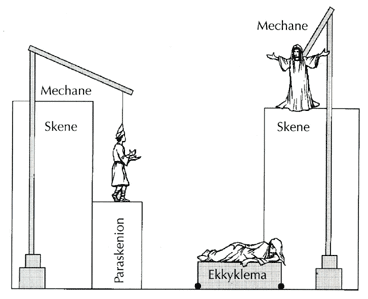
Greek dramatists and engineers collaborated to create early forms of stage automation. These included complex pulley systems, mechanized carts, and rotating platforms that enabled swift scene changes and special effects. The deus ex machina, a crane device used to lower actors playing gods onto the stage, exemplifies how technological creativity was woven into theatrical tradition.
In music, Greek thinkers approached sound not just as an art but as a science. Pythagoras studied the mathematical ratios of vibrating strings, revealing fundamental principles of harmony and scale. Aristotle further examined sound as a physical phenomenon, exploring its dependence on motion and medium. Vitruvius, though Roman, was heavily influenced by Greek traditions when he later analyzed acoustics and architectural sound design. These inquiries ultimately informed the development of resonant performance halls and acoustic instruments, such as the lyre and aulos, that still inspire modern equivalents.
Automata and Mechanical Marvels
The ancient Greeks were among the first civilizations to explore automation, crafting self-operating machines not merely as novelties but as demonstrations of natural laws and engineering prowess. One of the earliest known applications of this was the automatic temple door, designed to open and close through the principles of pneumatics and heat expansion.
They also invented mechanical alarms, such as a bell that rang when a door was opened, serving as an early form of security system. Among their most astonishing creations were:
The first known vending machine, which dispensed holy water upon insertion of a coin
A robotic servant capable of mixing and serving wine and water
A primitive steam turbine developed by Hero of Alexandria, which prefigured later steam-powered engines
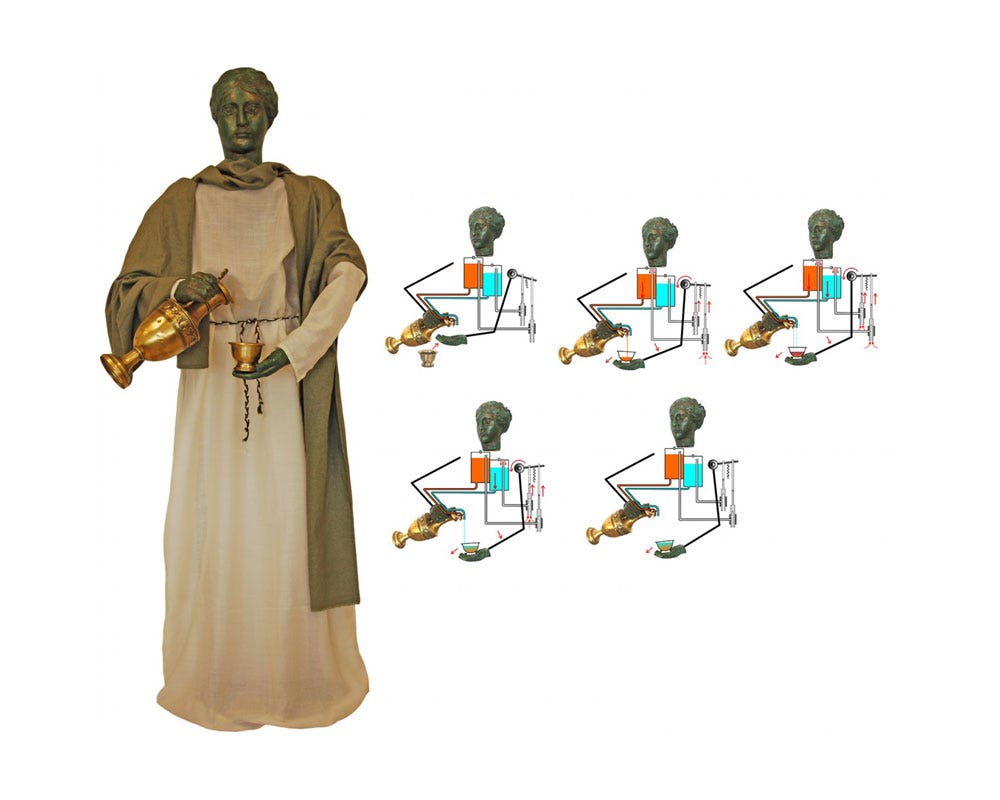
The automatic maid (replica), Museum of Ancient Greek Technology
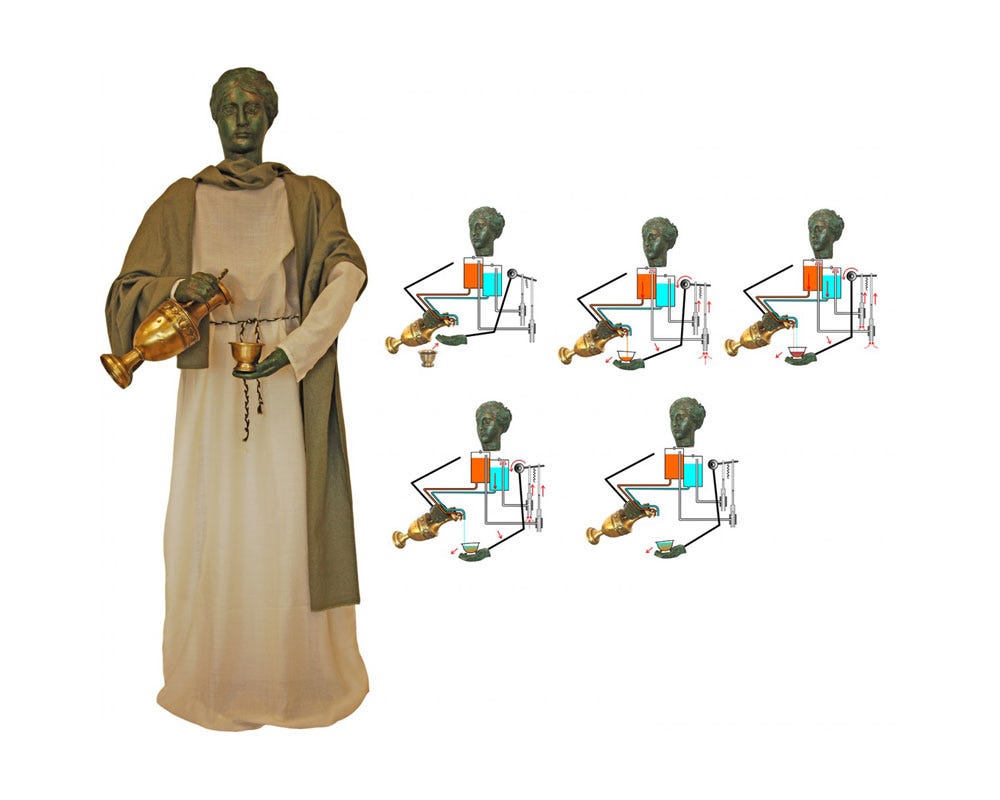
These devices were not merely technical curiosities but tangible manifestations of Greek curiosity and inventiveness.
Music, Games, and Intellectual Recreation
Music held a central place in Greek cultural and spiritual life. Beyond composing and performing, the Greeks approached music through rigorous scientific inquiry. Ptolemy and Pythagoras, among others, laid the groundwork for the mathematical analysis of harmony and pitch, contributing to early music theory and the tuning systems that would influence later Western music traditions.
Their intellectual curiosity also extended to recreational activities. Board games such as Pollis, an abstract strategy game reminiscent of chess, challenged mental agility. They developed puzzles and kinetic toys that demonstrate an understanding of physics and cognition, serving both educational and entertainment purposes.
Technological Innovation in Athletics
Sport was a cornerstone of Greek identity, deeply entwined with both civic pride and religious observance. Events such as the Olympic, Isthmian, Delphic, and Nemean games were as much demonstrations of technological precision as they were displays of athletic excellence.
To ensure fairness, engineers devised systems like the Hysplex, a starting gate mechanism that released runners simultaneously, eliminating the advantage of anticipation or false starts. Similar mechanisms were developed for equestrian sports, including calibrated release systems for chariot races, ensuring that competition was governed by skill rather than mechanical error.
Tools, Construction, and Everyday Mechanics
Greek innovations in construction technology transformed the built environment. Utilizing a range of simple machines including pulleys, levers, cranes, and winches, they devised methods to lift and maneuver massive stone blocks with unprecedented efficiency.
Among the most impressive feats was the mobile crane, a structure mounted on wheels and powered by capstan winches. This enabled builders to transport, elevate, and precisely position heavy materials, facilitating architectural achievements such as temples, amphitheaters, and fortified walls. The use of parallel wall-building cranes allowed for synchronized construction, improving structural accuracy and reducing labor demands.
Hydraulic Engineering and Water Management
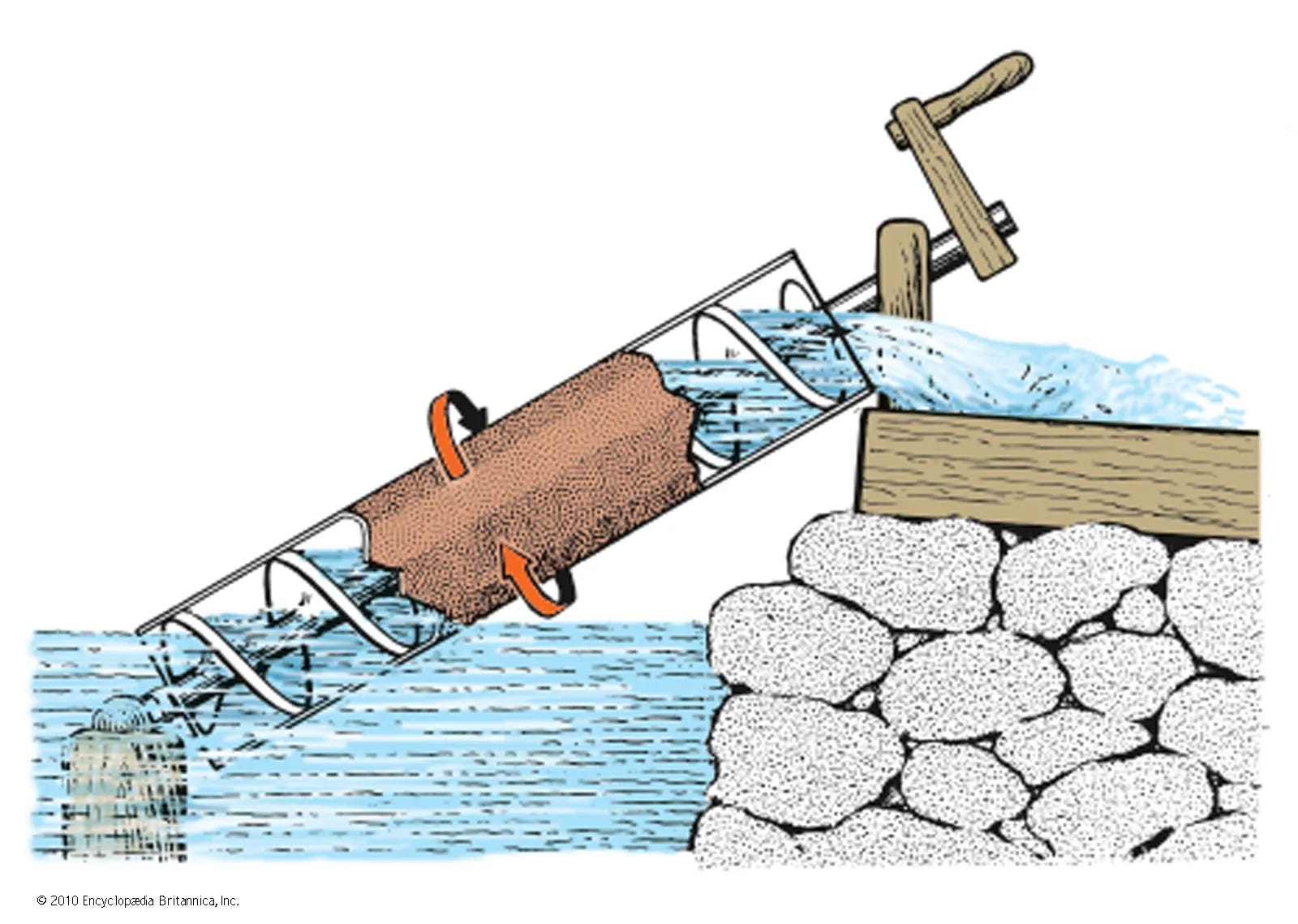
Water engineering was another domain in which the Greeks excelled. To optimize the use of rivers and natural water sources, they created systems of horizontal turbines, piston pumps, and Archimedean screws, the latter invented by Archimedes himself. These tools not only supported irrigation but also powered flour mills and other agricultural operations.
The hydraulic telegraph, an early long-distance communication system, used water pressure and synchronized signals to transmit messages between remote locations, an extraordinary precursor to modern telecommunications.
Machines, Gears, and Technical Instruments
The Greeks mastered the manipulation of mechanical components such as gears, screws, nuts, and cylinders, using them to build increasingly sophisticated devices. Hero of Alexandria, one of antiquity’s most prolific inventors, created numerous apparatuses that would resonate through the centuries.
His pantograph, for example, was a device that enabled artists and architects to replicate and scale drawings precisely. He also devised the earliest known coin-operated dispenser, a programmable mechanical theater, and the aeolipile, a steam-powered spinning device that is considered a proto-steam engine.
Military Engineering and Naval Supremacy
The Greeks understood that military superiority required not just strategy and manpower, but technological edge. They developed powerful siege engines, including battering rams and the polybolos, a repeating ballista capable of launching multiple bolts in rapid succession.
Archimedes’ war machines were particularly notable. He devised compound pulley systems for lifting ships out of the water, steam cannons, and even burning mirrors to set enemy ships ablaze from a distance.
Naval innovation culminated in the development of the trireme, a highly maneuverable warship powered by three tiers of oarsmen. This vessel was instrumental in decisive victories such as the Battle of Salamis, demonstrating the strategic value of superior shipbuilding.
Agriculture, Textiles, and Medical Instrumentation
Greek advances in agriculture and craftsmanship were both practical and visionary. They employed swing plows, dual-action looms, and screw presses for the extraction of olive oil, facilitating more efficient food production and trade.
In medicine, they engineered a range of surgical tools including scalpels, syringes, forceps, and bone saws, many of which resemble those used in operating rooms today. Their innovations laid the groundwork for clinical surgery and diagnostic practices.
Final Thoughts
The ancient Greeks were not merely theorists or artists. They were consummate engineers, inventors, and experimental scientists. Their technological achievements spanned nearly every facet of life, from the elegance of the theater to the precision of military machinery, from the harmony of music to the mechanics of hydraulic systems.
Modern civilization owes a profound debt to their relentless pursuit of understanding and innovation. Though we may now live in an era of digital marvels and artificial intelligence, the principles and prototypes forged by Greek hands over two millennia ago continue to guide and inspire our journey through the world of technology.
i think you mean meters
Interesting essay. Inventiveness doesn’t seem to be lineal, it leapfrogs from one culture to others. Perhaps the zeitgeist of a particular time and place fosters amazing advances. Then something arrests the development in a place. Greece and Italy are curious examples. The enthusiasm fades. I wonder how much our propensity to war contributes to the demise of creativity.