

Should We be Political?
Or Escape to the Garden?

Dear Classical Wisdom Reader,
Our little family has just returned home to the End of the World after a trip across the United States. Catching up with both old friends and family members in a few states along the way, I noticed a marked change in our discussions.
While the ever presence of politics still loomed, it was rare for my interlocutors to jump headlong into those murky and emotive waters. Whereas in the past, many were quick to recite their team’s headlines, champion their side’s positions and castigate their opposition’s efforts, this time long lost loved ones were brought back to life through restored video footage and old photographs. Happy snaps of furry friends were shown, inciting gleeful responses, and amusing travel adventures and mishaps were enthusiastically recounted.
Sure, politics lingered at the edge, but it no longer occupied center stage. And I must say, many seemed much happier for it.
Of course, you might be quick to point out that this small sample size is hardly evidence of any cultural shifts, one from which we could extrapolate more broadly. This observation is clearly anecdotal rather than scientific. And you would be right! Perhaps our friends and family just didn’t want to talk about politics to us!
Nonetheless, this personally experienced deviation from the political into the familiar was welcome, as well as the improved countenance of those we care about and with whom we were speaking.
Indeed, it was so much so, that it made me wonder: should we be political at all?
The Case for Civic Duty
This question may at first appear sacrilegious, something against one’s obligations to their nation and community. Yet, the idea that everyone should be political was not universally accepted in the ancient world.
Regular devotees to the Golden Age of Athens will no doubt recall the era’s posterboy, the famed statesman Pericles, and his well known statement on the topic. Not the often misattributed modern paraphrase, but the words straight from his mouth according to Thucydides (who, admittedly, put those words in his mouth).
“We do not say that a man who takes no interest in politics is a man who minds his own business; we say that he has no business here at all.”
Granted, this was a speech delivered at the beginning of the Peloponnesian War, intended to inspire citizens and reinforce civic responsibility. It was spoken by a politician addressing a wartime audience, and so it naturally emphasizes engagement. Nonetheless, the expectation of political participation as a duty is unmistakable.
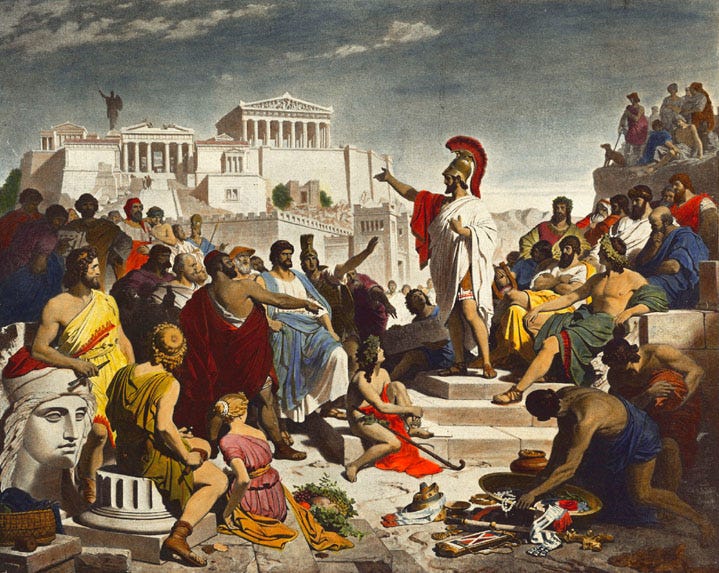
Similarly, advocates for the ancient philosophy of Stoicism know its stance vis-à-vis political involvement, a position that echoes the Athenian statesman about a century after his death. The Stoics held that humans are social beings, part of a rational and ordered universe governed by the logos. To participate in society, including politics, was to live according to nature.
The Stoic Roman Emperor Marcus Aurlius embodied this Stoic political principle, often citing the duty one has to their community. Likewise, the philosopher Seneca, who advised Emperor Nero, supported political engagement while also warning of its dangers. (Sadly he did not take his own advice, as readers who know the demise of Seneca will recall). As he wrote in On Leisure (De Otio, 3.2):
“The wise man will take part in public life, unless something prevents him.”
The qualification is essential. For the Stoics, political participation was the default, but it was not absolute. If public life corrupted one’s character, compromised one’s morals, or undermined virtue, withdrawal was justified. Virtue remained the highest good.
Essentially, they advocated that you should be political if you can do it well and ethically... but if you can’t, then it’s best to just focus on being a good human being first.
The Epicurean Retreat
Another ancient philosophy, however, went further. It did not merely qualify political engagement but generally advised avoiding it, and the anxiety it so often brings.
Proposed around 300 BC by the Samian born Epicurus, the eponymous philosophy was dedicated to finding a happy life, one that avoided pain and suffering. The central aim was ataraxia, which is often translated as tranquility or freedom from disturbance.
Epicureanism is in many ways much more accessible, approachable and easily comprehended than it is often portrayed. Pain is to be avoided and pleasure pursued. The key component, however, in understanding Epicurean philosophy is to not to think of later corruptions, specifically surrounding the world ‘pleasure’.
To Epicurus, pleasure was not indulgence, but simply life without pain, a goal best achieved by pursuing a simple life.
Contrary to popular modern depictions, it was not a decadent, hedonistic approach. (Indeed, that’s what the philosophy of hedonism is for!) Instead, according to Epicurus, food and drink should be basic, necessary and natural. Ambition, which brings anxiety and conflict, should be moderated and instead, one should cultivate friendships, enjoy thoughtful conversation, and engage in quiet reflection.
Epicurus practiced what he preached. In 306 BC, he established “the Garden”. This was more than just a place, it was a way of life. A private house and garden outside the city walls, cut off from the mess and noise of the political realm, where all were welcome. In fact, unlike other schools, which were typically restricted to elite men, the Garden included women and enslaved people, too.
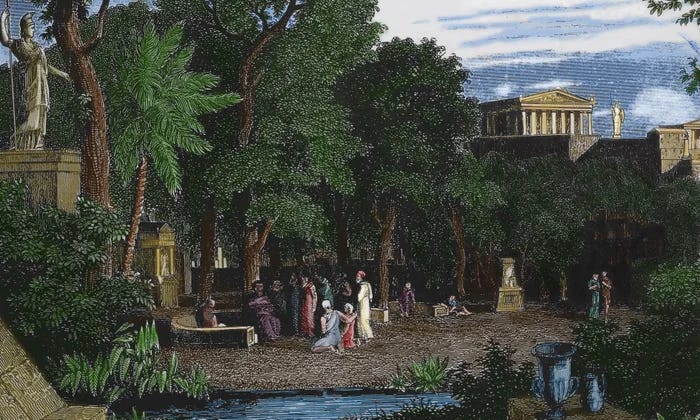
Within this community, members focused on simple living, friendship, and the removal of fears, especially the fear of the gods and of death. Moreover, pertinent to the conversation at hand, was a deliberate withdrawal from public ambition, including politics.
That said, Epicurus did not impose an absolute prohibition. Political involvement could be justified if it was necessary for security or stability, or if withdrawal was not possible. Still, the general recommendation was clear: politics, more often than not, disrupts tranquility.
Between Duty and Tranquility
Epicureanism and Stoicism, near contemporaries, are often presented as opposing schools and almost combative and yet, they actually enjoyed a considerable amount of mutual respect. It was a famous rivalry, but one in which the Heraclitian tension and conflict spurred and refined each one more and more.
If we are to focus on the differences, of course, we can find a lot. Much ink has been spilled over the millennia detailing those divergences. Yet on this question, they share an interesting overlap.
Both place something above politics. For the Stoics, it is virtue. For the Epicureans, it is tranquility. In both cases, political involvement is secondary and conditional. If engagement threatens the higher goal, stepping back is not only acceptable but necessary.
Of course, determining when that threshold has been crossed is far from straightforward.
This brings us to our weekly topic of discussion, one that has very real and relevant implications in our here and now. No matter which corner of the earth you happen to inhabit, screaming headlines will confirm that, whether or not we are active, politics happen as an inevitable and real part of modern life.
The question, then, is not whether politics exists, but how we relate to it. It’s an area we can enthusiastically lean into…. or try to opt out of.
So what should we do? Should we be political?
Is it important for everyone to be involved? Or only some?
Is it a universal obligation, or a selective one?
Can we live better lives if we, at least some of the time, take our leave?
Join the conversation below...
All the best,
Anya Leonard
Founder and Director
Classical Wisdom
Those who refuse to engage in politics will be ruled by their inferiors
"Good men do not wish to rule their fellow men."
Thus we pretty much only find bad men in politics. Power corrupts, and it attracts the already corrupt. In the first case, those honest few who innocently pursue it hoping to better things, often end up revolted by it and leaving, or turned by it into what they hate.
In the second case, what better position to seek, if one wishes to be a criminal unmolested by justice, than the seat of 'justice' itself?