

Saved by the Smoke...
Do We Need More Ritual in our Lives?

Dear Classical Wisdom reader,
The old man at the neighboring farm had died. His son had promised to return and take care of the place, but it was painfully evident to all of us that he had not yet come. It was a sweltering day, over one hundred degrees, and no one had provided the deceased’s apiary with water.
So the bees did what they had to do in order to survive: they took over our pool.
The small water hole, supplied from the aquifer below, had already become a vital source of hydration for the local insects and wildlife. Birds flitted in and out, beetles skimmed the surface, and lizards hovered nearby. Once a bat even came for a dip!
Dear daughter was already struggling to overcome her very human fear of wasps and other stinging, winged creatures in order to cool herself. The sudden influx of bees was not helping her cause. Yet the house had no air conditioning, the heat pressed down on us all, and retreat was not an option.
Something had to be done.
Fortunately, our hosts were not only gracious but knowledgeable. A small bonfire was constructed, fed with branches of rosemary whose scent curled into the air. Arming dear daughter (as well as myself) with the smoking herbs, we marched with purpose and resolve, like priestesses approaching the oracle at Delphi, arms extended, solemn and intent. In our imaginations there were drums and measured steps, a sense of ceremony that transformed fear into focus.
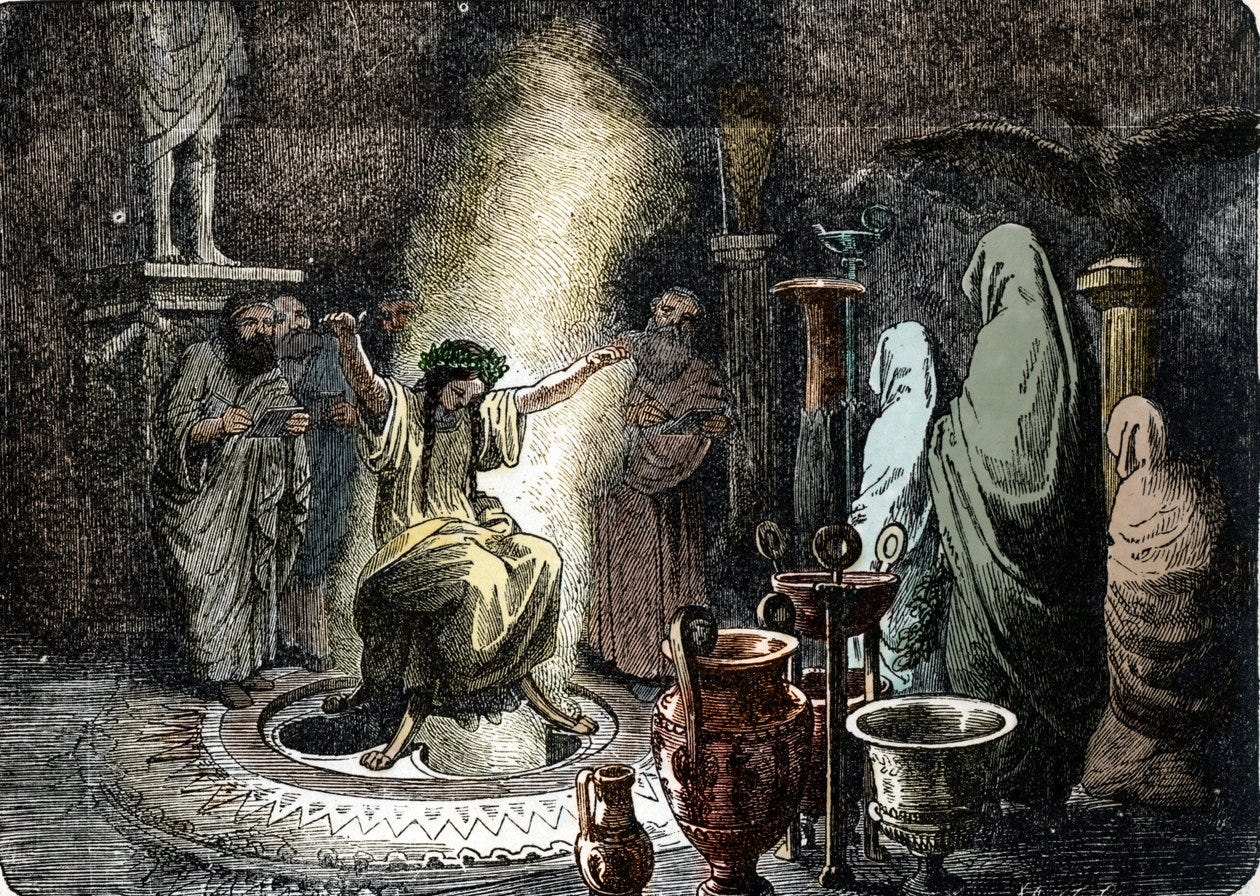
The bees, calmed by the smoke, yielded the water. And so we jumped in.
As her now invigorated face beamed with pride, I couldn’t help but notice what had truly changed. The ritualized act itself had done the work. It encouraged her, emboldened her, reassured her. This was no mere distraction...It was a meaningful response to danger, one that imposed order on chaos.
The ancients, of course, understood this instinctively. Ritual was not ornamentation; it was necessity.
In ancient Greece, when a city was struck by plague or famine, purification rites, or katharmoi, were performed to cleanse communal guilt and restore harmony with the gods. Individuals, too, relied on ritual to navigate life’s great thresholds. A young Athenian soldier about to depart for war might dedicate a lock of hair to Apollo, acknowledging both fear and hope in a single act.
Meanwhile Roman society, ever practical, marked moments of triumph and terror alike through ceremony: generals celebrated victories with triumphal processions, while households conducted solemn funerary rites to guide the dead safely into the afterlife.
These rituals did not erase suffering, but they gave it shape, meaning, and boundaries.
Discover more ritual and religion in the ancient world:

Later that day, while reminiscing and contemplating the events of the previous year, a friend lamented the difficulties he had endured. He spoke anxiously of 2026, longing to leave behind the pains of 2025.
Once more, I thought: perhaps a ritual might help?
Not superstition, but intention... A deliberate act, like writing down the year’s burdens and burning the page, or washing one’s hands in water while naming what must be released. Even something as simple as a shared meal to mark an ending can restore a sense of agency, a feeling of control.
After all, modern life is rife with transitions that can go unacknowledged... burnout, puberty, retirement, failure... even death has lost so many accompanying (and often reassuring) customs...
Perhaps ritual may be one of the few tools we have left to process them fully?
Yet, at the same time, the ancients were also keenly aware that rituals could go terribly wrong.
Greek tragedy offers many stark warnings. Agamemnon’s decision to sacrifice his daughter Iphigenia in the hope of favorable winds for Troy stands as one of the most chilling examples of ritual gone awry.
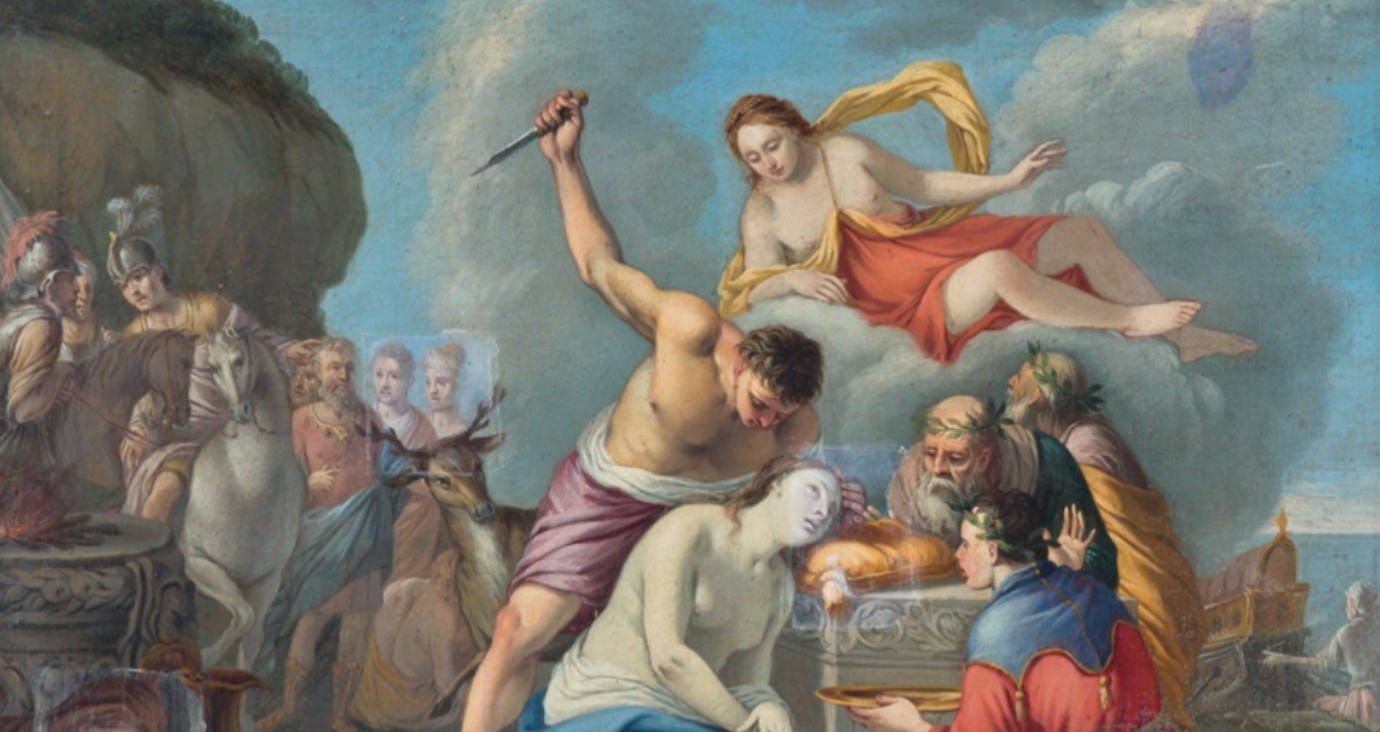
Roman history, too, records moments when ritual crossed into desperation: during the Second Punic War, human sacrifices were reportedly buried alive beneath the Forum in an attempt to stave off catastrophe. These acts reveal the dark edge of ritual...the danger of surrendering judgment to fear, of mistaking cruelty for piety.
So where does this leave us, dear reader?
Should we be encouraging ritual?
Does it still have a place in our increasingly secular world?
Is it the glue that bonds us together, offering shared meaning in moments of vulnerability?
Or does it risk binding us to superstition and the irrational?
Add your thoughts below, and contemplate the role (or lack thereof) of ritual in modern life...
All the best,
Anya Leonard
Founder and Director
Classical Wisdom
ritual seems important to the human psyche-and that's what religion is for,to my way of thinking
I really appreciated how grounded this was.
There’s no big theory being argued, just a pool, heat, fear, and a response that actually worked. And somehow that makes the point more clearly than anything abstract could. It made me think that ritual doesn’t have to be elaborate or perfectly preserved from the past to be real. It just has to be intentional, embodied, and shared.
Our life today tends to break everything up into private feelings and isolated moments. Ritual pushes back against that. As if to say this moment isn’t just random, it belongs to something larger. Even very small acts can do that. As you mentioend: Writing something down and burning it or washing your hands while naming what you’re letting go of.
Importantly, none of that denies pain or pretends things are fine. It gives the pain a shape and a boundary so it doesn’t spill into everything else. Really does make one wonder if some of our exhaustion isn’t even from suffering itself, but from carrying it around without any form at all.