

Pericles’ Funeral Oration: Why Study It?
Plus: Classical Wisdom Litterae on The Peloponnesian War

Dear Classical Wisdom Members,
Of all the orations of all the world... Perhaps none is as famous as Pericles’s.
But why did the Athenian statesmen’s words ring so resoundingly throughout the ages? Why did his speech on the values of democracy, the importance of civic duty and the need for moral virtue maintain their relevance... even to this very day?
Another example, dear reader, of when history touches on the universal...the timeless... the truth.
So today, we take a look at another important aspect of his (or should I say Thucydides’) immortal and enduring words: that of Sacrifice.
Classical Wisdom Members: This article comes from our Classical Wisdom Litterae Magazine dedicated to the Peloponnesian War, which you can enjoy in its entirety below. We delve into the ins and outs of this historic event, the scandals and the sickness and the remarkably important role of slaves.
The famed Classicist, Edith Hamilton believed the Peloponnesian War was the most relevant for understanding the tumultuous 21st century... what do you think? Is that still the case?
Let me know in the comments or in our notes section...
All the best,
Anya Leonard
Founder and Director
Classical Wisdom and Classical Wisdom Kids
An Oration to Sacrifice
By Van Bryan
It is the close of the first year of the Peloponnesian war. Athens, no stranger to war, finds itself mourning those who had fallen on the field of battle, the sons and fathers lost. As was customary in Athens, the bodies of the deceased had been collected and displayed under a tent for three days. During this time, various citizens paid tribute and the families were allowed to say goodbye to their loved ones. After the three days, a funeral procession would be held where an esteemed citizen would make some small speech on behalf of the lost.
And so it was around the year 430 BCE that Pericles, the Athenian general and statesman who rose to prominence during the golden age of Athens, would be selected to address the city.
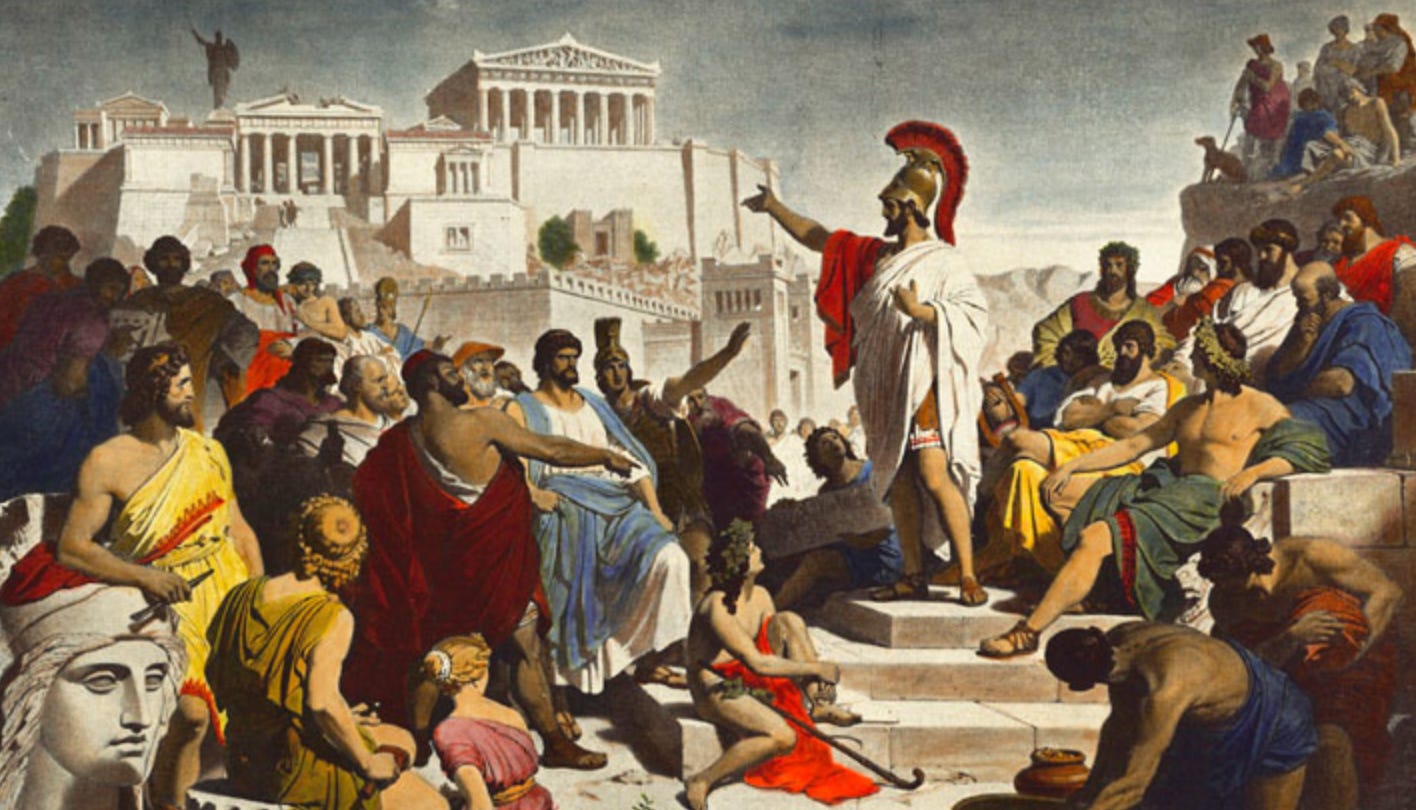
While Pericles’ funeral oration undoubtedly reflects the sentiments of the statesmen, we must remember that the text was not transcribed verbatim. Thucydides would have written the funeral oration some time after the actual speech, giving him ample time to reword and edit anything he pleased. However we can still be reasonably sure that the text by Thucydides is a faithful representation of the actual funeral oration.
As Pericles took the stage, he made clear his concerns about such a speech…
