

Pagan or Christian?
Plotinus and the 'Perfect Life'

Dear Classical Wisdom Reader,
They seem worlds apart…
But there’s much that connects them.
We like to think of the world as having set categories, with hard boundaries separating one thing from the next.
Yet those lines can be very blurry, and we are always locked in a conversation with the past.
So today we’re looking at Plotinus, a key figure in the history of philosophy. As the founder of Neoplatonism, he bridged the seemingly far-removed pagan and Christian worlds.
He is among the foremost interpreters of Plato from antiquity, and his philosophy was influential on Christian thinkers. Moreover, his work also shares similarities with many other religious traditions…
So, what did he think made up a perfect life?
And, in the end, was the man himself truly a pagan or more of a proto-Christian?
In the spirit of philosophy, read on, and make up your mind for yourself!
All the best,
Sean Kelly
Managing Editor
Classical Wisdom
Plotinus: Pagan or Proto-Christian?
by Ed Whelan
Plotinus (c. 205-270 AD) was one of the most important philosophers of late antiquity. He is often called the founder of Neoplatonism, an interpretation of the philosophy of Plato. He was a moral and religious philosopher concerned with humanity’s ultimate happiness, and he believed that happiness could only be attained if a person identifies with the highest thing in the universe. The work of Plotinus influenced many philosophers and was respected by Christian thinkers.
Taking a page from Plato, Plotinus argued that happiness was the contemplation of the Forms. These Forms are the eternal ideas and ultimate source of reality. Plotinus believed that the ‘perfect life’ was possible if a person contemplated the Forms and lived a life of reason.
The Life of Plotinus
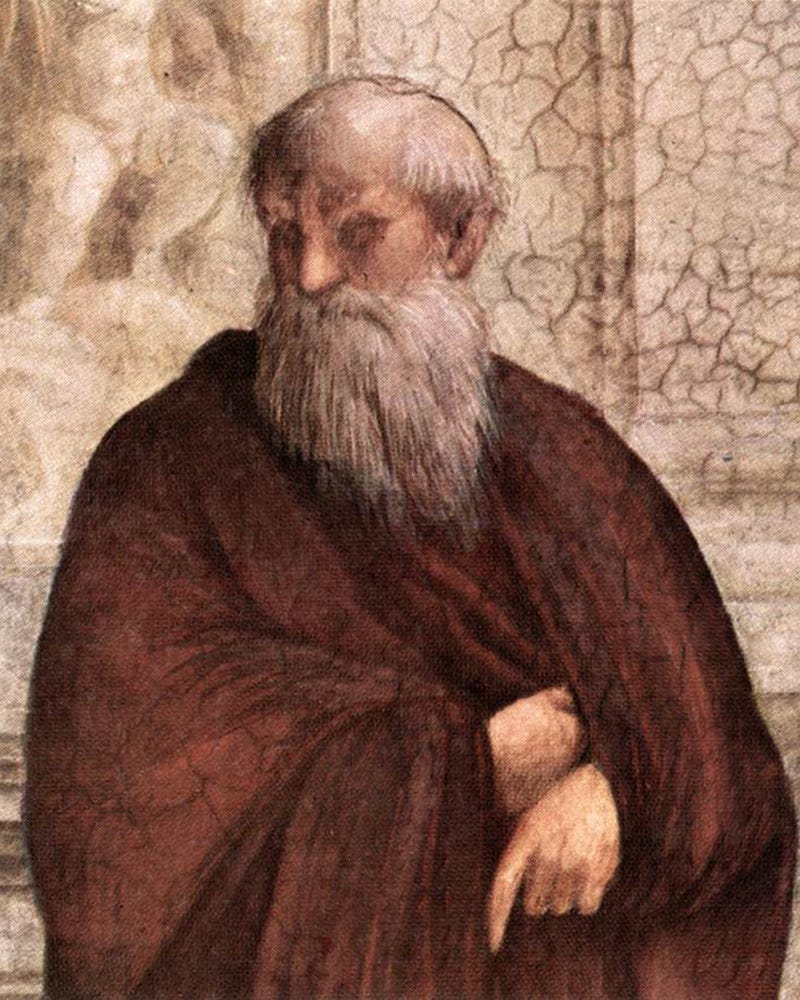
There are few records of Plotinus’ life. It has been claimed that he was born in Egypt, yet his name is a Latin one, and he was deeply influenced by Hellenic philosophy and culture. At the age of 28, Plotinus decided to study philosophy, becoming the pupil of Ammonius. Ammonius also taught several other prominent thinkers, including the Christian theologian Origen.
In 250 AD, Plotinus accompanied Emperor Gordian in his invasion of Persia. It was later claimed that Plotinus went along because he wanted to meet the wise men of Persia and India. After the death of the Emperor, Plotinus was lucky to return to Roman territory with his life. Later he went to Rome, where he became a teacher of philosophy.
Plotinus was both a man of action and an intellectual. He became friendly with Emperor Gallienus and tried to persuade him to build a new city in Italy modeled on the teachings of Plato. It seems that Plotinus was very well-connected; many leading Romans made him the guardian of their children in their wills.
The Philosophy of Plotinus
Plotinus was a disciple of Plato, but he interpreted the great philosopher in a new way, and in doing so developed a new philosophy. Plotinus argued that the transcendent and indivisible exists. It is neither being nor non-being, and is the ultimate form of reality.
In philosophy, this concept is known as the Monad, meaning “the One”. Plotinus argued that all things, including everything we see around us, has its source in the One. Things emerged from the One without any act of creation; they simply emanated from the transcendent reality.
In the Enneads, Plotinus compared the One to the Sun which emanates light but is not diminished by this. The most important emanation from the One is the World Soul, followed by Nous (intelligence). Human souls and being, or matter, have their source in the World Soul. Plotinus believed that just as everything came from the One, everything seeks to return to union with the One.
For Plotinus, the meaning of life was unity with the One. This could be achieved intellectually by the mind (Nous). By contemplating the world and not being attached its material manifestation, the mind is elevated. This can lead to ‘henosis’ which is the mystical union of the human soul with the ultimate reality: the World Soul and then, ultimately, the One. In this way, humans can become whole and, it is suggested, attain a form of perfection due to the dissolution of the self with the One. There are many religious interpretations of Plotinus’ work. Modern scholars have also noted similarities between Plotinus’ work and Buddhist and other Eastern traditions.
The Influence of Plotinus
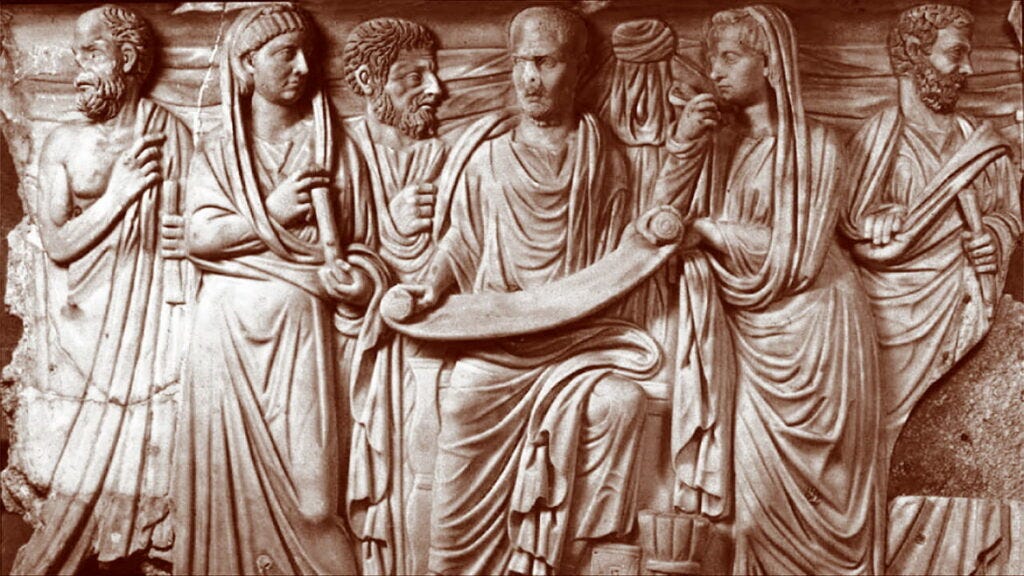
Plotinus’ teachings led to a growing interest in Plato and many regard him as the founder of the Neo-Platonic School of thought. This was not only influential in philosophical circles but also contributed to a revival in paganism among those opposed to Christianity. After the death of Plotinus, the Christian Church became very influential, becoming the de-facto state religion during the reign of Constantine the Great. Emperor Julian the Apostate, the last pagan ruler of Rome, was very influenced by Plotinus and attempted to restore paganism, but he failed.
Want to go in more depth?
Become a Member to access ALL our resources, covering everything from the Age of Homer through to the rise and fall of the Roman Empire and beyond.
Members get the FULL Classical Wisdom experience, including exclusive podcasts, e-books, in-depth articles and more, including this week’s exclusive Members article on the history of writing.
So join today!
Ironically, despite his popularity with anti-Christian thinkers, Plotinus was also influential in Christian circles. Many scholars have also detected the influence of the Neo-Platonist in medieval Jewish and Muslim thought. The mystics, in particular, have been influenced by his writings throughout the centuries.
Conclusion
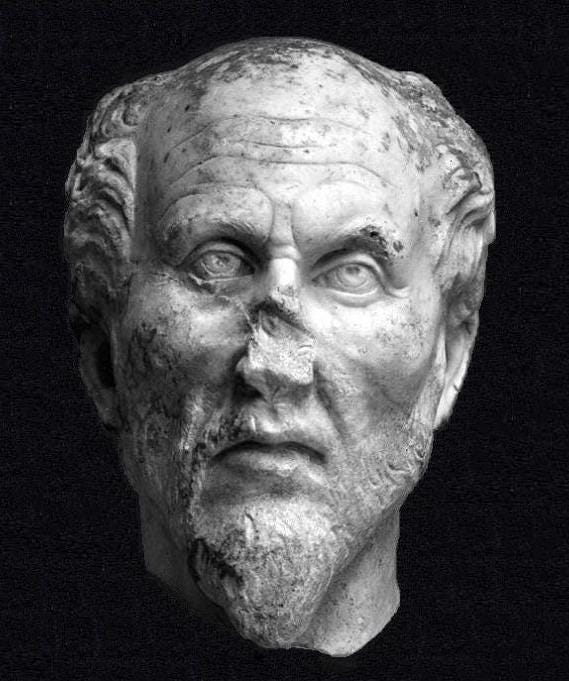
Plotinus was one of the most important thinkers in the late ancient world. He created a new philosophical school based on the teachings of Plato in which he developed a metaphysical system based on the One. He believed that individuals could achieve happiness by unifying with this transcendental reality through the use of their intellect. His work was very influential in his own time and beyond, even contributing to a pagan revival in the 4th century AD.
Plotinus had such a captivating perspective on the world and how we fit into it. His vision for one transcendent being which emanates all of reality can’t help but be true in one way or another.
What do you think of his idea that aligning oneself with the universal is the path to happiness? I want to believe that being fully immersed in the universe (including full compassion for others) is the path to happiness, but sometimes I doubt. Is there a limit to the infinite sacrifice we can give on behalf of the universal?
For Plotinus, Nous emanates from One before the World Soul. Mind or understanding is superior to the Soul.