

Odysseus' REAL Identity
Have You Been Tricked?

Dear Classical Wisdom Reader,
We have a fun one this week.
There’s few ancient stories more celebrated than the Odyssey, and few ancient heroes as well known as Odysseus.
Of course, Odysseus (or Ulysses to the Romans) is famously something of a trickster… Known for his clever ruses and deceptions, of which the Trojan Horse is just one.
But what if there was an even bigger trick going on? What it Odysseus…. wasn’t really Odysseus?
After all, identity is a key theme in the Odyssey, with Odysseus’ name and status shifting again and again across the epic, from the king of Ithaca, to “no-one”, to a beggar…
Read on below to discover a novel and daring re-interpretation of Homer, which may just have you questioning the whole epic.
(Of course, this is just an interpretation, but a fun one nonetheless!)
Now, if you’re interested in the world Homer, you won’t want to miss tonight’s special webinar event.
Anya will be in conversation with Emily Wilson, the author of widely celebrated translations of the Odyssey and the Iliad. That's TONIGHT at 3PM EST.
This is a rare opportunity to take part in a live event with one of the world’s most high-profile translators of Homer.
Register below to join us!
Can’t join us live? Register in advance to receive the recording.
We hope to see you there!
All the best,
Sean Kelly
Managing Editor
Classical Wisdom
Odysseus’ REAL Identity?
by Alberto Majrani
Who really killed the suitors in Homer’s Odyssey? A careful reading of the epic poem reveals a myriad of clues left by Homer with a surprising conclusion: Ulysses was not…really Ulysses. He was the expert Achaean archer Philoctetes in disguise!
With this key, the Homeric poem suddenly assumes a logic and coherence hitherto unsuspected. This explains why Homer continues to praise the art of deception: it is he who has deceived us for three thousand years! And the surprises do not end there: all the apparent inconsistencies of the Iliad and the Odyssey that have plagued students and teachers for generations, known as the “Homeric Question”, now fall effortlessly in place. The ancient texts finally agree with historical and archaeological data, fully revealing the genius of their author.
It’s a strange story, that of Ulysses. Is it possible that the King of Ithaca stayed away for twenty years, missing his homeland, abandoning a beautiful nymph who would make him immortal, only to return to a wife no longer young after a dangerous solo crossing?
And when he does return, nobody recognizes him, not even his father or his own wife, so he kills all the pretenders threatening to provoke a bloody revolution, and finally, when he would have every right to a little peace and quiet, he decides to sail away in secret, leaving everyone baffled! All right, yes, it is a mythological tale, but it is not very…logical!
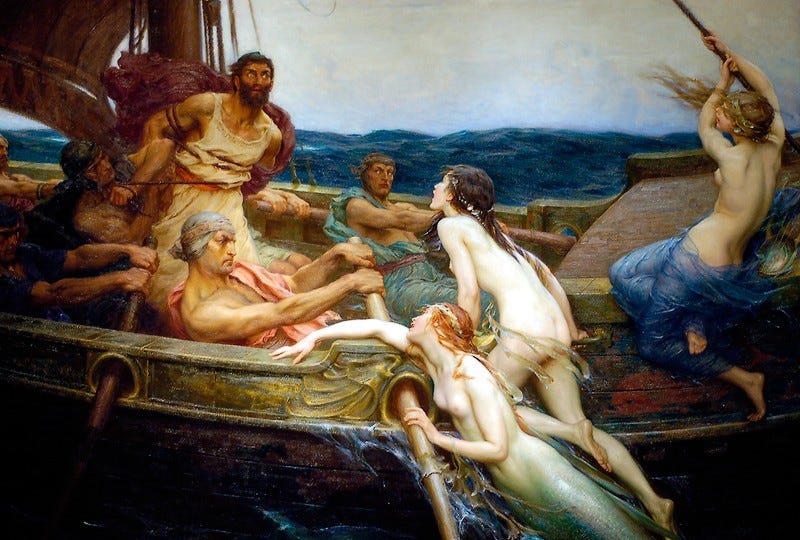
And what if Ulysses was not actually…Ulysses? Let’s examine the hypothesis that the son of Ulysses, Telemachus, had hired a mercenary to interpret Ulysses and to slaughter of the suitors asking the hand of his mother Penelope: the same Telemachus would then cast a poet to tell a fantastic story that could justify all the years of his father’s absence. All this in order to free the royal palace of all the suitors eating them out of house and home. Not to mention that if someone had married his mother, Telemachus would have lost his right of succession to the kingdom.
In fact, Penelope was of noble birth, being the daughter of the powerful King Ikarios, while Ulysses was an “upstart” tradesman familiar with piracy and looting, activities which, at that time, were not clearly defined. The claimants themselves were plotting to get rid of him, and he had to anticipate them as soon as possible.
Who was this mercenary? Can you imagine? Think about it…it is suggested to us by Ulysses himself…when he is in the land of the Phaeacians. Ulysses claims to be the best of the Achaeans in archery, immediately after Philoctetes!
As for Philoctetes, who was he? Maybe someone remembers him thanks to the amusing cartoon “Hercules”, produced by Disney in 1997, in which the script writers got a bit too carried away by the need to invent a fun story. They changed the events and roles of various mythological characters. It’s best, then, to refer to Classical sources.
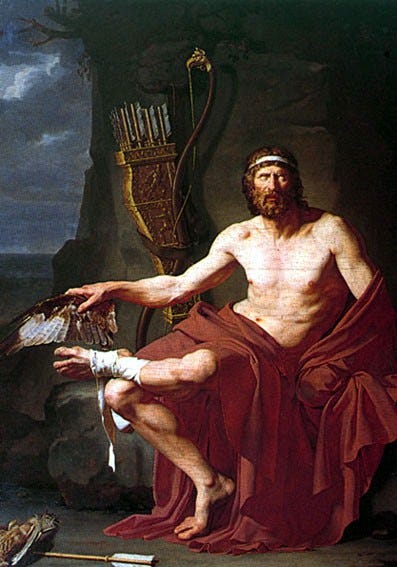
The Iliad tells us that Philoctetes was the head of a contingent of the Achaeans headed to the Trojan War. However, he was bitten in the foot by a snake, a serious wound that became infected and forced his teammates to abandon him on the island of Lemnos. As Sophocles recounts in his play Philoctetes, according to a prophecy, Troy would fall only with the help of Hercules’ weapons. Philoctetes had been a pupil of Hercules and had inherited his bow and arrows, so after being cured by the Achaean doctor Machaon, Philoctetes kills Paris, decisively contributing to the defeat of the Trojans.
Of course! The mercenary was Philoctetes! That explains a lot: he had known Ulysses for some time—that lent itself well to interpret him– he also was a “family friend” and therefore may have been more willing to risk his life in such a dangerous undertaking. He was an extremely skilled archer, requiring a level of training that Ulysses could not have maintained after so many years at sea.
Interested in Greek mythology? Members can now access this week’s special in-depth article on the story of Elektra by Mary Naples, one of the great family dramas of ancient myth and a cornerstone of Greek tragedy.
That is assuming, of course, that Ulysses was really equipped with this skill: as the Iliad recounts, Ulysses never uses the bow, even during the games in honor of Patroclus, in which he won wrestling and running competitions. And when he finally does have a bow in hand—borrowed from the young warrior Meriones—all he does with it is whip horses!
Note also that Homer does not say that Philoctetes was abandoned on Lemnos on Ulysses’ orders: this is the work of subsequent mythographers and repeated by Sophocles, who reworked the old myths to build on his story–not very different from the authors of Disney. So there is no reason to think that Philoctetes was harboring resentment against Ulysses or his family members.
The youth of Ithaca would not have recognized Philoctetes, but some elderly people might, so it was necessary to leave the island as soon as his mission against the suitors was accomplished. He had been seriously wounded in the foot by a snake, which would have left him with some obvious lameness. In fact, Homer, without saying so openly, does everything to make us understand that the mysterious stranger limps: he walks slowly, leaning on a cane, is likened to the god Hephaestus, who is lame too. There are many strange references to “feet”, for example the old nurse who recognizes “Ulysses” by his knee injury caused by a wild boar (which is never mentioned either in the Iliad or the rest of the Odyssey, in which the legs of the runner Ulysses are absolutely perfect), a recognition that comes just as she washes his feet. Perhaps it had more to do with the foot than the knee!
But Philoctetes was not content with his substantial reward— i.e., all the precious objects Telemachus loaded on his ship when he sailed off—he aspired to eternal glory! And since he could not reveal the deception, he was lauded as one of “the best of the archers Achaean” by the great “Ulysses” himself.
That same “Ulysses” even alludes — in the poem dedicated to him — that there was someone better than him in the art of archery. His words are something of a Freudian slip, a kind of “Message in a Bottle” launched to posterity, as if to say: “he who has ears to hear, let him hear!”. Homer has left a host of similar messages throughout the poem that guide us through the actual course of the action.
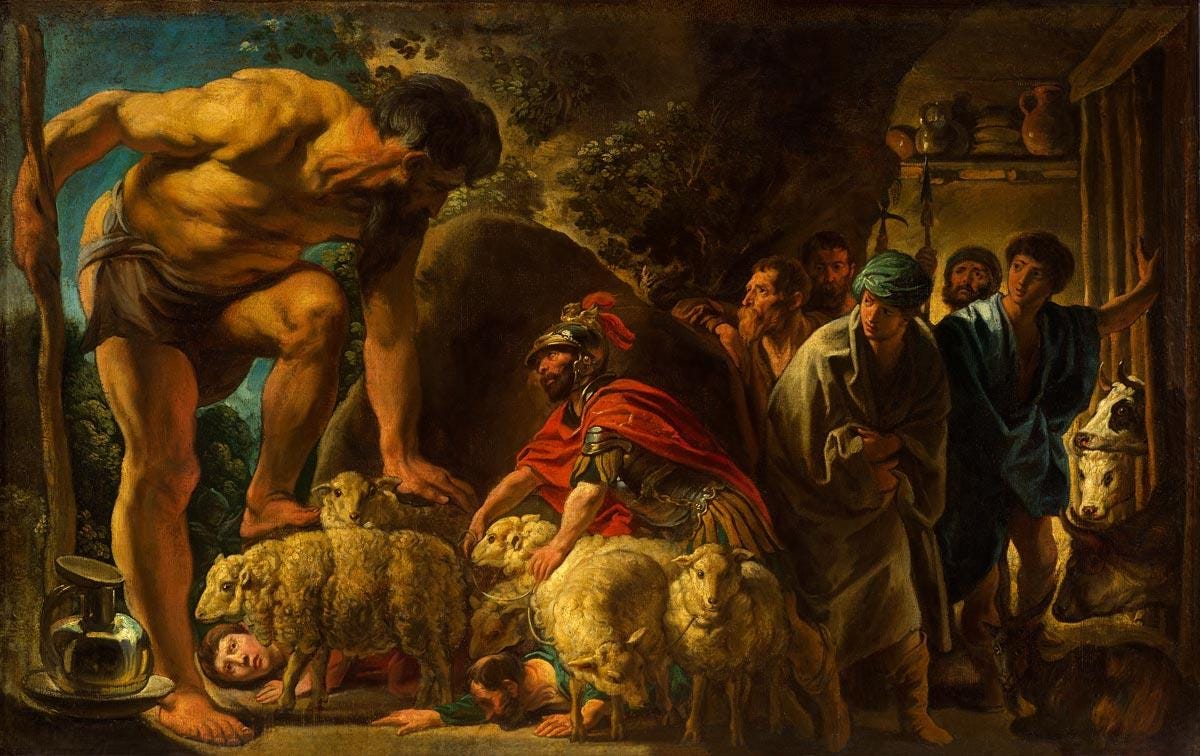
As for the real Ulysses, he had probably died long before, killed in battle or drowned at sea. This can be deduced from the fact that, throughout the Odyssey, the idea that the hero is now deceased is repeated several times. What about the fact that at some point Ulysses descends into the underworld? Or the episode in which his name is Nobody, so the cyclops Polyphemus will repeat that ‘Nobody’ blinds him, ‘No-one’ kills him? Other messages in bottles, which.. no one, so far, had taken literally!
And again, does it not appear very suspect the extraordinary coincidence in time, that Ulysses would return to Ithaca after two decades, and within hours his son is landing on the same beach, located on the opposite side to the main port?
Also, what should we infer from traditional biographies which say Homer was blind? It could be that the poet was looking for a justification for not recognizing he who passed himself off as Ulysses?
Let’s reconstruct the affair, let’s imagine how could it have taken place in reality. There is a power vacuum in Ithaca; the king left for decades and never came back. The suitors are plotting to eliminate Telemachus and take over the kingdom, so he sets sail with a ship full of precious objects to hire a mercenary. Philoctetes comes and performs the massacre with the help of the most faithful servants, whom, as the swineherd Eumaeus and the cowherd Philoetius take the trouble of informing us, will be adequately rewarded
The fake Ulysses cannot stay there pretending nothing had happened, because sooner or later someone will recognize him. So he sails off again, leaving Telemachus the kingdom… and they all lived happily ever after.
The Odyssey is not a fairy tale for overgrown children, but an intricate maze filled with ingenious references that will inevitably escape those who do not study it closely. Quandoque dormitat bonus Homerus – “Even good old Homer nods,” Horace proclaimed– but maybe Homer was a lot more awake than we thought!
“Never mentioned” - Odysseus’ scar story is recounted twice in Odyssey Book 19 lines 393 to 508, a long section to ensure we understand the account of his being gored by a boar above the knee. First Eurycleia, his old nurse speaks and recounts the details of his visit to his grandfather when he was injured. Sorry this does not fit your argument – but it cannot. Please correct. All the best.
Odysseus upon returning to Ithaca was first recognized by his dog and then by the woman who took care of us upbringing. She recognized the scar he got when young during a hunt. Others did not recognize him similar to many of us not recognizing people when they get older. As a teacher for many years, I often do not recognize a student I had thirty years ago; we change. As far as his wife, many do not recognize their husbands in later years as opposed when they were more virile and young. They will say where is the person I married? This goes for recognition of wives by husbands as well but not as much.