

Is Eating Meat Moral?
Carnivores vs Vegans: What is better?

Dear Classical Wisdom Reader,
I didn’t eat any meat until I was 18. My parents weren’t part of a cult or hippies or anything like that... nor did I have some especially virtuous moral position, like a teenager with a cause. And while we had plenty of pets growing up, it was mostly because I was just picky. I thought meat was too chewy, and over time the label of vegetarian became so entwined with my identity that it was hard to shake.
You have to remember, of course, this was before vegetarianism became the thing it is today. I didn’t know a single other veggo. At McDonald’s I could eat the buns and fries. That was it. Most restaurants had -maybe- one meat-free option, if they had any at all.
I was outright laughed at when I lived in foreign countries (which, to be fair, was pretty understandable in Kazakhstan... being a nomadic culture and all).
I was only able to explore my culinary options once I went to college and just... didn’t tell anyone. Nonetheless, by eschewing meat, along with beans and a number of other healthy foods, I ended up much shorter than everyone else in my family (including my Depression-era grandmothers), and I’m scrawny to a fault.
Now, of course, I live in the land of meat consumption and enjoy ojo de bifes with quite some regularity…
So I won’t lie: my relationship with meat is a little... complicated.
Perhaps because of that, it’s hard for me to be entirely unbiased in this debate…one that has grown considerably over the last few decades: the morality of eating meat.
I thought about this when speaking with Massimo Pigliucci, who has been very vocal about his thoughts on whether or not we should consume those who fly, trot or slither. He argued that we think ourselves so moral today, but perhaps in a hundred years our descendants will look back on us as horribly bestial for eating animals.
The interesting thing, of course and as always in these humble pages, is that this isn’t a new debate. Far from it. The ancients, the world over, wrestled with the morality of eating animals and arrived at very different conclusions.
It will come as no surprise to anyone with even a passing familiarity with the Indian subcontinent that some of the earliest sustained philosophical arguments for vegetarianism emerged in the East. Beginning around the 8th and 6th centuries BCE, Parshvanatha and Mahavira, the 23rd and 24th tirthankaras of Jainism, revived and championed ahimsa, the ancient Indian principle of nonviolence toward all living beings.
Jainism, with its uncompromising commitment to nonviolence, is not the only tradition to advocate vegetarianism. The ancient Indian work Tirukkural, generally dated to the early centuries CE, explicitly and unambiguously praises abstaining from meat and condemns killing as virtues for ordinary people…not merely monks or ascetics.
Moving westward to the Hellenes, we find the Orphics, a popular and mysterious religious movement that spread through Greece around the sixth century BCE. Many sought to live an ascetic life, free from spiritual contamination, and abstained from eating animals as part of their religious practice.
They shared much in common with another famous philosophical movement of the time, including, according to some ancient sources, an aversion to those icky broad beans.
At this point, there are no doubt many of you thinking of the most famous ancient vegetarian of them all: Pythagoras!
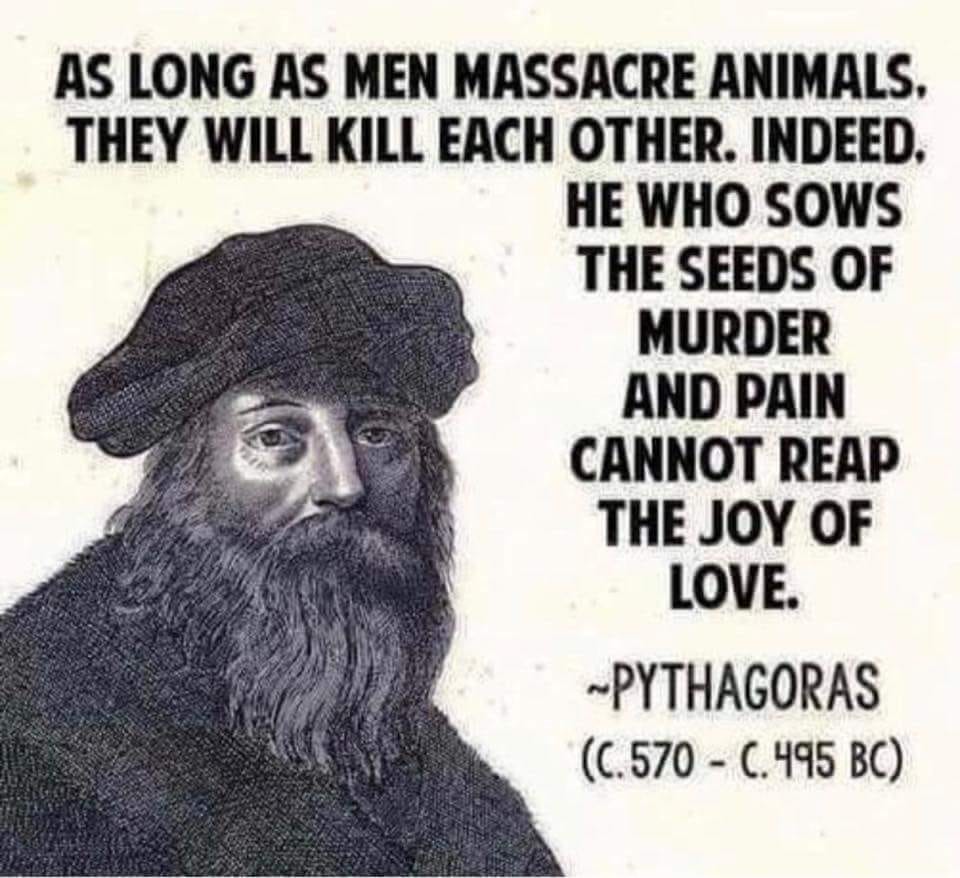
In fact, before the word vegetarian was coined, vegetarians in English were often referred to simply as Pythagoreans.
Unfortunately for anyone hoping for a clear answer, the ancient sources don’t entirely agree. Some record Pythagoras as participating in animal sacrifice, while others insist he abstained from killing altogether. Eudoxus of Cnidus (c. 400–350 BCE), quoted by Porphyry, wrote:
“Pythagoras was distinguished by such purity and so avoided killing and killers that he not only abstained from animal foods, but even kept his distance from cooks and hunters.”
It is this image of Pythagoras that ultimately won out. Thanks in large part to Ovid’s vivid portrayal, he has come down to us as antiquity’s great champion of vegetarianism, a reputation reinforced by generations of later Pythagoreans who continued to live by the same ideals.
Of course the main reason Pythagoras championed abstinence from animal consumption was their belief in the transmigration of the soul. He was lampooned for his ideas regarding reincarnation, described as recognizing his friend in a dog’s bark.
So yes... you probably wouldn't want to eat an animal if there was even a chance it was your late uncle.
Vegetarianism also appears in the ancient world beyond Greece. Around the first century BCE and CE, the Moesi, a people living in the northern Thracian region (roughly modern-day Serbia and Bulgaria), were described by ancient writers as subsisting on honey, milk, and cheese, while abstaining from meat.
Support the Classics and bring the wisdom of the ancients into your inbox! From History and Philosophy to Mythology and Literature… we have you covered on all things Classics.
Subscribe today to unlock our Member’s Only articles and resources:
Not everyone agreed, of course.
For instance, Aristotle considered that animals existed, at least in part, for the sake of us humans. He argued that while they possessed perception and sensation, they didn’t have reason, a capacity unique to mankind.
Likewise, the Stoics came to a similar conclusion, albeit for different reasons. Only rational beings can participate in concepts like justice or moral community, and therefore humans owe a duty to each other… but not to animals.
Interestingly, beneath this question of diet lay a much larger one… which is: what, exactly, separates human beings from the rest of the animal kingdom?
So, with our very brief (and by no means exhaustive) tour of ancient vegetarianism concluded, let’s return to the debate at hand... should we -or should we not- eat meat?
While this is, at its heart, an ethical question about the value of an animal’s life, it has also become fertile ground for today’s culture wars, especially when it comes to sustainability, climate change, food production, and population growth. Those concerns, at least in their modern form, would have been largely foreign to the ancients.
So where does this leave us, dear reader? Should we eat meat? Is it moral?
And does that answer change in light of what we now know about nutrition, animal cognition, and the technologies we now possess?
Join us in the comments and take part in a conversation that has been unfolding for millennia.
All the best,
Kind Regards,
Anya Leonard
Founder and Director
Classical Wisdom
What isn’t moral is the way we confine and literally torture millions of animals. Pigs in gestation crates where they can’t turn around and live on concrete, for years. Piglets getting castrated and teeth removed without anesthesia. Chicks tossed into grinders because they’re male and can’t lay eggs. Dairy cows repeatedly impregnated, calves taken at birth so we can take their milk, repeat until collapse then send her to McDonald’s. Said male calves put in crates to be veal. Chickens bred to grow so big so fast they can’t walk and have heart attacks. Chickens hung in shackles live by their legs then slid across a blade. Gas chambers for pigs is the latest method. Animals on transport trains or ships in boiling heat or freezing cold, for days or even weeks. I like to think the one cow my grandparents kept in their pastured, then slaughtered each year, was perhaps moral. But today’s factory farms and industrial animal system is decidedly not moral at all.
If we abstained from eating meat, the planet would be in much better shape. We would use much less water, generate far less pollution, and permit vast stretches of land to do something other than grow feed for animals.
If we abstained from eating meat, our health would probably improve (although there is some controversy about this claim).
Nature does not endorse veganism. In fact, it evolved carnivores. Of course, nature is amoral. Darwin famously observed how suffering is part of the natural order. Humans seem to be the only omnivorous species with individuals who abstain from eating meat. That makes humankind special. It doesn't argue for the correctness of veganism, but it's nice to know that my veganism is a rare and special power.