

Can We Predict the Future?
Oracles and an Octopus

Dear Classical Wisdom Reader,
The World Cup is on!
And, well, the question on everyone’s lips is: which country will win?
Of course, we can’t predict the future… yet neither can we resist the urge to try.
So sometimes, well, we’re happy to let others do the predicting for us.
And the results can be, ironically, unexpected.
A relevant, recent (by our standards!) example happened back during the 2010 World Cup tournament, when there was the famous case of Paul the Psychic Octopus.
Yes, you read that right…
Paul was an octopus that correctly ‘predicted’ the results of several matches. His handlers would present him food in two different containers, each marked with the flag of a nation with an upcoming match against the other.
Whichever container Paul went for indicated his ‘prediction’.
And, well, Paul ultimately had a remarkable eight win streak.
Along the way, he received widespread media attention, and even death threats from those who felt his predictions were dooming their own teams to failure.
Now, all that may seem silly, but wanting to know the future has been a core human impulse since time immemorial.
And, of course, the ancient Greeks were no exception. Yet, then as now, it did not always go smoothly.
Herodotus tells the tale of the famously wealthy King Croesus. He consulted the Oracle at Delphi when deciding whether to go to war against Persia.
He was told by the oracle that if he goes to war, ‘a great empire will fall’.
It wasn’t until after he went to war and failed spectacularly that he realized the great empire he was destroying was his own.
The Oracle answered Croesus’ question, but the disastrous interpretation was entirely the King’s own.
Such was the role played by the enigmatic Oracle at Delphi: to deliver divine, cryptic messages… but leave the exact meaning to the listener to interpret.
So, today we’re looking at how this most mystical of roles shaped the ancient world, her famous and mysterious maxims, and eventual decline and disappearance…
Meaning that, no, she can’t give any World Cup predictions!
All the best,
Sean Kelly
Managing Editor
Classical Wisdom
The Delphic Oracle
By Mónica Correa
Centuries ago, from every corner of the Mediterranean, people traveled to Greece to get answers about their life and future from the Oracle of Delphi.
It was there that the god Apollo was said to speak through a woman chosen by local priests. The woman chosen was known as the Pythia.
The Pythia delivered her oracles over a cleft in the ground of Apollo’s temple, which itself was constructed around 800 BCE on Mount Parnassus. She breathed in the vapors which emerged from the cleft, and delivered her famously cryptic messages. Over the years, many different women would take on the sacred role and pronounce their prophecies, but they were always inspired by the same vapors.
Apollo sent his messages through the Pythia to those who needed them… as well as to those who could afford them. This was how it happened for the twelve centuries the oracle was active.
How was life at Delphi?
While at least four temples were built for Apollo at Delphi, there were many more around the ancient Mediterranean world. In fact, Delphi was not even the only ancient city with an oracle. It was, however, the most significant.
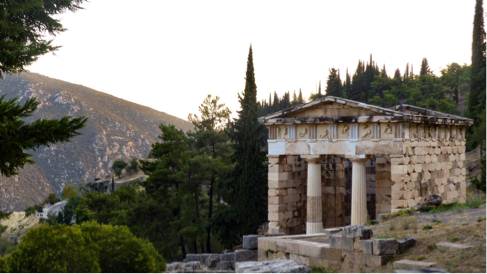
While the oracle was active, wealthy people and leaders from different territories occasionally paid to get to the front of the line to see the oracle. We know about them because the ones who paid a lot of money are immortalized in stone inscriptions. Indeed, there are records that state that the Pythia was sometimes forced to make her predictions by the temple priests in order to satisfy rich clients.
Interestingly, these aren’t the only stone inscriptions… Despite wars, the rise and fall of different empires, two messages still survive to this day on the entrance of the temple: “Know thyself” and “Nothing in excess”.
The Oracle and its messages
According to some records, the oracle delivered its pronouncements on an annual basis; the day chosen for the event was the seventh day of Bysios, Apollo’s birthday.
Other records state that nine times each year the Pythia initiated into her trance state, and gave Apollo a voice to deliver his messages. These sessions were held on the seventh day after each new moon in spring, summer, and fall. It did not occur during winter because Apollo was believed to have gone north to the land of the Hyperboreans (a mysterious race of people who lived “beyond the north wind”).
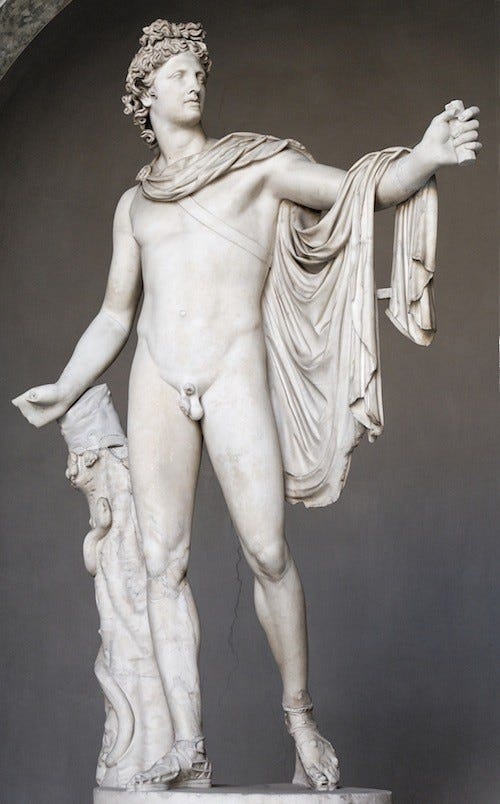
The Pythia was always a woman from Delphi, regardless of her age or social class. While she was serving as oracle, she lived in the sanctuary, abstained from sexual activity, and fasted on or before the days scheduled for oracular sessions.
During days of oracle activity, the Pythia would initially be brought by priests of the temple from a private residence and led through a series of purification and religious rituals before her performance. Eventually she was led down into the inner sanctum of the temple (the adyton).
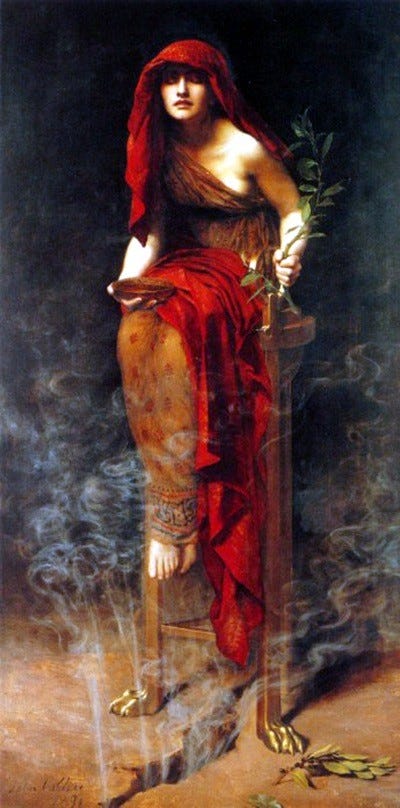
Rulers and wealthy citizens of the known world (as well as famous philosophers) made the journey to this mountainous site to make the most important decisions of their lives… and the lives of those around them. Indeed, war and peace were determined by these messages.
Oracles are one thing…. but how have DREAMS shaped history?
Members can access an exclusive extract from The Ancient Interpretation of Dreams, by Mirjam E. Kotwick, Associate Professor of Classics at Princeton University.
Discover how some of history’s most important events were decided from what the ancients saw when they slept…
Not a Member? Sign up today to support the Classics and unlock ALL of our resources, including exclusive podcasts, in-depth articles, and more.
The Vapors of Delphi
For centuries, researchers underestimated historical validity of the story of the cleft and vapors because they couldn’t find any geological indicators of them. However, ancient writers such as Plutarch, Homer or Euripides described the vapors and modern studies are finally validating their reports. Evidence from a chemical analyses of water samples and travertine deposits in the adyton have shown that the springs on site have in the past and continue at present to emit small volumes of hydrocarbon gases.
The Oracle started its decline in late Hellenistic and early Roman times. In 389 CE, Theodosius I started persecutions against the old religion and prohibited the cult of Apollo and the celebration of the Pythian games in honor of Apollo. By 391 CE, Christianity was the exclusive state religion and older temples were closed.
Even though temples were shut down and the oracle was “silenced”, splendid structures still stand today, preserving the magnificent, if not fantastic, history of the Pythia and the Oracle of Delphi.
Now visitors go to the Temple of Apollo at Delphi to look into the past, rather than the future.
There do exist some people who have the knowledge to predict the future in great detail, by looking in their client's eyes. Their predictions are so accurate, that many people shun them because they are afraid of the accurate knowledge, which could be favorable or non-favorable for them. How the Oracle of Delphi predicted and to what degree the predictions were accurate is not known. This vapor thing, they talk about, is a false hinge because the priests wanted to make money from their rich clients. When money is involved, procedures become aberrated and twisted and truth and accuracy are the first victims.
I have read that Alexander the great went to the Oracle of Delphi for predictions before he embarked on his long campaign. I have also read that Alexander wanted to go to India to learn how the great yogis of India performed the miraculous, mind-over-matter feats. Too bad his armies wanted to return home from the campaign, prematurely. Too bad, Alexander died young in Babylon. We don't know what he learnt from the yogis, or if he met any. How his attitude to life changed is revealed by how he treated King Porus, after defeating him in the greatest battle of his campaign, where Alexander got severely injured and almost died. This fact indicates his attitude to life did change. Did he reveal any of this to his friends close to him, for example, Hephaestion, who was his closest friend and high-ranking general. Alexander did announce that he wanted to make the world, a peaceful place where people cooperated with each other for advancement rather than fighting each other for decline.
Similarly, some Tarot Card readers are very accurate in their evaluations. Is there a science to this capability? Can anyone learn this from a master? I think not. It seems it is a gift, but how do they do it? I asked one woman-predictor in Germany, how she does it. She said when she looks in the eyes of her clients and observes the minute details of the features of the cornea, the knowledge comes to her. Is some knowledge inborn in some people? Science doesn't think so. What do you think?
So many memories related to that, wow.