

Caesar Vs Alexander
Who Had the Greatest Legacy?

Dear Classical Wisdom Reader,
You might have heard it before.
There’s a famous quote from Isaac Newton: "If I have seen further, it is by standing on the shoulders of giants."
Of course, Newton meant this in terms of scientific discovery… But I like to think it can be applied to the world of history, too.
And sometimes, it’s actually giants that are standing on the shoulders of other giants; those we think of as historical figures, themselves looked back on history for inspiration.
Julius Caesar, of course, was no exception. He was very aware of those who went before him… not least Alexander the Great, whose legacy cast an immense shadow.
So, today’s article looks at the respective legacies of the two conquerors, and how despite being separated by centuries, they came to have a ‘meeting’ of sorts when Caesar was in Cadiz.
But before we get to it…
You may have noticed, we’re running with a bit of a ‘Caesar’ theme this week. After all, it’s nearly the Ides of March!
And to mark the occasion, we have a very special offer.
Until midnight this Sunday, March 15, you can join our growing Classical Wisdom community for 15% OFF our annual memberships.
That’s 15% OFF for March the 15th.
Membership unlocks ALL our resources, including :
our exclusive Podcasts with Professors series, featuring Anya discussing the world of the Classics with world-renowned experts
our vast e-book library of classical texts, including works by everyone from Homer to Marcus Aurelius, featuring bonus material by Classical Wisdom contributors you won’t find anywhere else
Our Classical Wisdom Litterae magazine
Exclusive in-depth articles
And more!
You’ll also be the first to hear about special Members-only offers and events, and be a part of an ever-growing community of like-minded enthusiasts.
So don’t miss out this: This is a rare opportunity to go deeper in to the world of ancient history, philosophy, myth and literature, all at a a special price.
So join today!
All the best,
Sean Kelly
Managing Editor
Classical Wisdom
Caesar and Alexander
By Giuseppe Aiello
It is the year 69 BC. Gaius Julius Caesar, now more than thirty, is in Cadiz. Here, one step away from the famous Gates, where the Mediterranean flows into the ocean, Caesar wanders around the temple dedicated to Hercules, the mythical Greek hero. Suddenly, he stops in front of the statue of another half-god, Alexander the Great, who died at the age of not yet thirty-three, in 323 BC.
Plutarch, in his Parallel Lives, and Suetonius in the Lives of the Caesars tell us of the incident. To those who asked for the reason for his subdued weeping before the effigy of the Macedonian king, Caesar replied that he could not suffocate his pain. He saw how at 32 (the same age as himself) Alexander had left behind in death a massive empire that he had created; Caesar felt he had not yet himself completed a noteworthy undertaking.
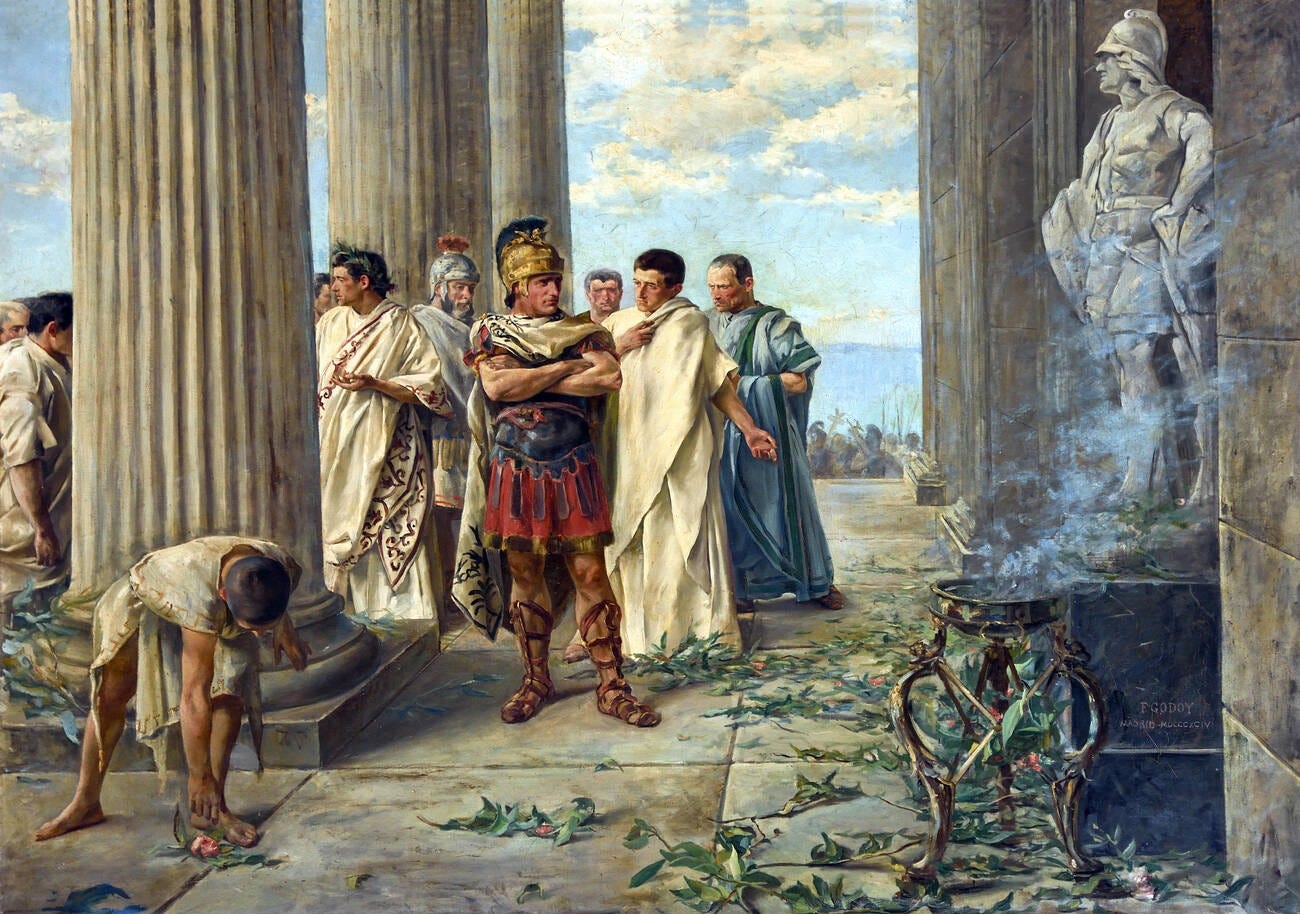
The thirty-second year of the lives of both Alexander and Caesar were significant; it was the end of existence for the first, and the beginning of an exceptional and vital path for the second.
When Alexander died, he left in the greedy hands of his successors a kingdom in which the sun rose on the Indus delta, and set down diving into the Adriatic. Like hungry lions in contention with a great shred of fresh meat, Perdiccas, Antigonus, Ptolemy, Seleucus, and the other Macedonian generals, divided the immense empire of Alexander among themselves.
Death took Alexander when all that could be conquered had been subdued: Greeks, Macedonians, Phoenicians, Syropalestinians, Egyptians, Armenians, Persians, Indians … Myriads of men and women of different races and lineages lived in relative serenity, in the shadow of the royal mantle. The Hellenization of distant worlds (worlds that the Hellenic themselves called “barbarians”) found its main vehicle in the Alexandrian army. Thanks to the exploits of the Macedonians, the overflow of the Hellenic language, customs and intellectual systems mixed with lands, also rich in history, spontaneously producing that epochal phenomenon that we call “Hellenism”.
It was not a forced imposition, where the people were compelled to assume the characteristics of the dominator (thus repudiating their own). Instead, it created by an extraordinary osmotic process of mutual assimilation, in which the habits, laws, and costumes of the winners and vanquished mixed together. Producing a new reality, this development gave way to the flourishing of the Hellenistic age.
When, at the age of 32, Alexander left earthly life and entered in to universal myth, he had already given a full display of his military genius. The battles of Granico (334 BC), Isso (333 BC) and Guagamela (331 BC) have exceptional importance within the history of mankind.
Thanks to them, and the success of Macedonian weapons, the great Persian King Darius III, enemy par excellence of the Hellenic world, was yoked to Alexander’s cart. The glorious lineage of the Achaemenids was extinguished.
Alexander’s immense accomplishments had given the impression of belonging more to the genus of the gods than to that of mortals… and so he was recognized as divine.
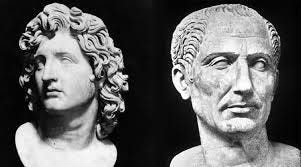
The Caesar at Cadiz, in contrast, seemed at that moment to be fatally delayed on the road to imperishable glory. He was already a decade older than that young man who, at a little over twenty, had created a new world in triumphing over the bare and sandy plains of Asia. But at 32 years of age, Caesar was far from leading his legions into one of the great battles that would make his fame immortal. He had not yet had the opportunity to show off his political and warlike genius. However, fate (or Fortuna?) had great things in store for him.
Julius Caesar had a further five decades of life ahead of him, a period of time that he was able to fully exploit with a vigor, skill and mental lucidity that few other men have been able to show in the course of history.
The time that Caesar enjoyed was relatively large: fifty-six years, of which the second half was vibrant. It was enough years for him to accomplish much of his purpose. It’s a fascinating exercise to hypothesize what else Caesar could have designed (and put into practice) if he had more time available, before the blades of the conspirators dramatically lowered the curtain on his life.
Get 15% off FOREVER:
Sign up to a Classical Wisdom Membership this weekend before MIDNIGHT on Sunday 15th of March.
Membership unlocks the FULL Classical Wisdom experience, including exclusive podcasts, in-depth articles, e-books and more!
Don’t miss out: sign up now!
The Triumvirate, the campaigns in Gaul, and those against Pompey and his followers, the vicissitudes of Egypt alongside Cleopatra… the last decades of his life were certainly full of epochal events.
The works he performed were certainly extraordinary, and unworkable by any of his other contemporaries. Here is his imperishable greatness…and yet his work was profoundly human, linked to rational intentions and thoughts.