

Aeschylus' Oresteia
The Tragic Trilogy
Dear Classical Wisdom Reader,
It was such a hot topic of discussion.
When I was younger, it was the time of trilogies - whether it was the Bourne films, the Lord of the Rings series, the Pirates of the Caribbean or whatever else - everything seemed to come in threes in those days.
The question was always asked amongst my friends - what was the best trilogy?
I’m not sure what my answer would have been then, but nowadays I have a nerdier (but I would say more correct) answer…
Which happens to be the subject of today’s article!
The Oresteia by Aeschylus is the only surviving trilogy of plays from ancient Greece. Considered one of the indisputable masterpieces of antiquity, its influence and legacy are vast.
And its subject matter couldn’t be me more significant - the bloody legacy of the past and the birth of democracy.
Check out the article just below, but if you’re interested in learning more about ancient literature, mythology, and philosophy, then there’s never been a better time than now.
This Labor Day weekend ONLY you can become a Classical Wisdom Member for 30% OFF! And best of all, this price is forever:
This offer expires on Monday at midnight, so ACT NOW and don’t miss out!
Membership perks include our in-depth articles, exclusive podcasts with professors, Roundtable Discussions with authors and intellectuals, and FULL access to our entire E-book collection as well as our online Classical Wisdom Litterae Magazines.

Don’t miss this chance to go deeper with the Classics!
So if anyone asks YOU what the best trilogy is, you’ll know how to answer them…
All the best,
Sean Kelly
Managing Editor
Classical Wisdom
Special Offer for a Limited Time! Become a Member for 30% Off FOREVER this Labor Day weekend only! Gain complete access to our archive of EXCLUSIVE podcasts, webinars, e-books and more! Offer ends Monday so don’t miss out:
Aeschylus’ Oresteia - A Masterpiece of Tragedy
by Sean Kelly
The Oresteia of Aeschylus is a truly remarkable work. It is the only surviving trilogy of plays from ancient Greece, and is amongst the earliest Greek tragedies that we still have – countless others were lost. Most importantly, it tells a compelling and powerful story with great artistry. Set between the events of the Iliad and the Odyssey, it revolves around the dark history of the mythical House of Atreus, and the establishment of the Greeks’ greatest legacy: democracy.
Agamemnon
At the beginning of the first play in the trilogy, titled Agamemnon, much action has already taken place. We are presented with a watchman on the rooftop of the palace of Mycenae, ruled over by the descendants of Atreus. The King, Agamemnon, has been absent for years, fighting at Troy. The watchman ominously tells us that since he has been away, the house is not well run the way it used to be. He can’t reveal the details, as ‘an ox is treading on my tongue’. The watchman then bears witness to far away signals, informing him that the fall of Troy has taken place: the king will be returning soon.
We are then told the mythic backstory of the play through choral odes; at the outset of the expedition against Troy, the Achaeans faced unfavourable winds at Aulis. The expedition was led by Menelaus, the slighted husband of Helen of Troy, and his brother, Agamemnon. In order to appease the goddess Artemis, and therefore calm the winds, Agamemnon chose to sacrifice his daughter, Iphigeneia. There has been much debate over who precisely is to blame for her death. Is Agamemnon responsible for his actions? Or did the goddess force his hand?
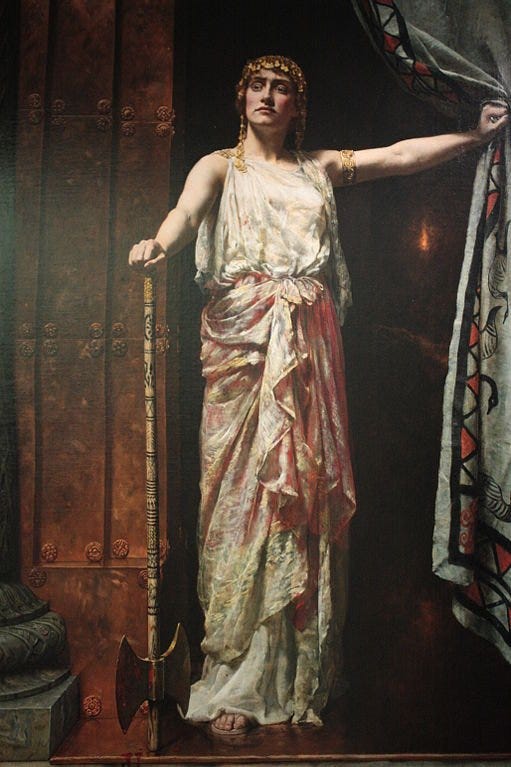
To Agamemnon’s wife, Clytemnestra, there is no ambiguity. She blames her husband for her daughter’s death, and awaits the opportunity for vengeance. With Troy having now fallen, she knows it’s only a matter of time before her husband returns to the palace, after a decade of absence. Making matters worse, when Agamemnon does arrive, he is not alone. He has brought the famed Trojan princess Cassandra to the palace as his concubine.
Cassandra, of course, famously has the gift of prophecy. This is most strikingly illustrated upon her arrival at the House of Atreus. She foresees her own imminent death, as well as the dark history of the family. Despite some slight reservations on the king’s part, Clytemnestra is able to manipulate Agamemnon into a sense of security. Along with her lover Aegisthus (the cousin of Agamemnon), Clytemnestra murders both Agamemnon and Cassandra. The play ends with Clytemnestra triumphant, but the tale is far from over…
Libation Bearers
In the second play in the trilogy, Libation Bearers, many years have passed since the events of the first play. Orestes, the son of Agamemnon and Clytemnestra, has grown to be a young man. Having been raised away from the palace, he must now seek out his mother, whom he has never known. Yet this is not to be a joyful reunion. He knows that she is responsible for his father’s death and is planning on murdering her in retribution. Orestes is trapped by the contradictory laws of his times: he is compelled to take vengeance on his father’s killer, yet he is naturally forbidden from murdering his own mother. The laws never anticipated family drama like this!
Before any confrontation, however, he stops at the tomb of his father, and leaves a lock of his hair before departing. His sister Elektra, (in one of her many appearances in Greek tragedy) later arrives at the tomb. She sees the lock of hair, as well as a footprint, and from these deduces that her long-absent brother is alive. (Perhaps more plausibly, there is also a piece of clothing she made for her brother many years prior). This scene is somewhat infamous. Even to the ancients, it seemed like an improbable conclusion for someone to arrive at. The tragedian Euripides parodied the scene in his own version of the Libation Bearers story, simply titled Elektra.
Nevertheless, the two long-separated siblings eventually come to recognise each other in a moving scene, and plan to work together against Clytemnestra. They offer libations at their father’s tomb, and what follows seems to suggest that Agamemnon, although in Hades, still is able to exert some sort of will upon the mortal plane.
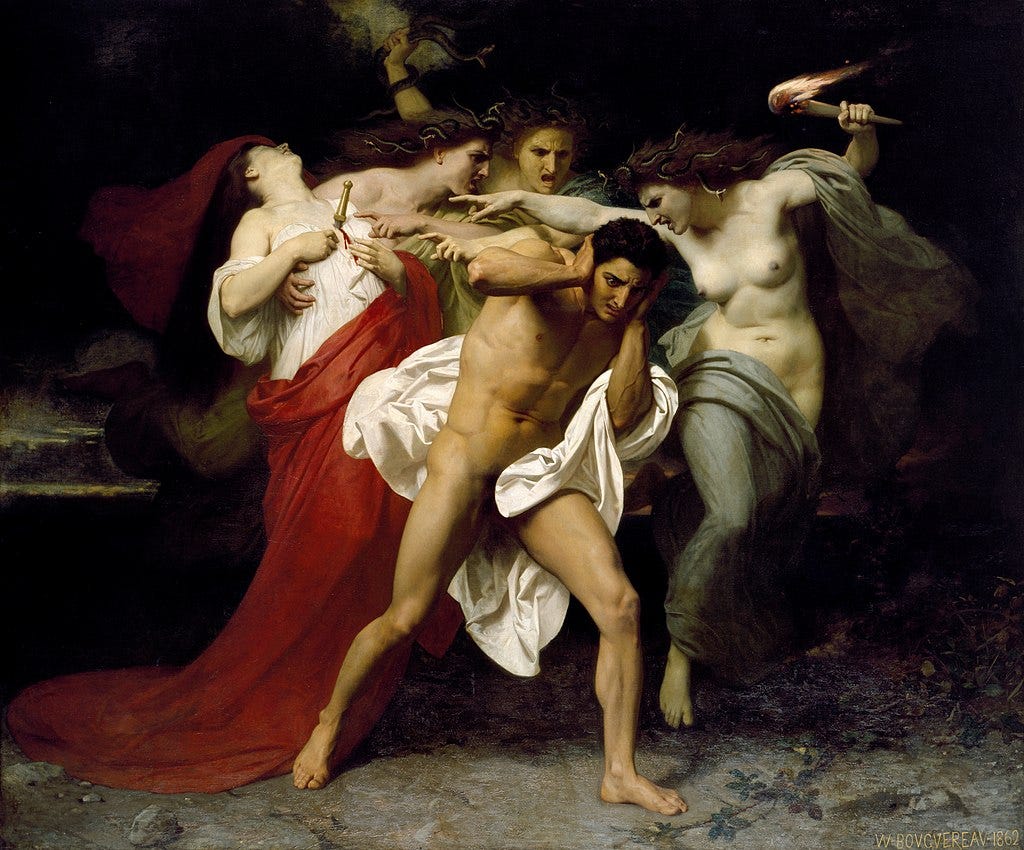
Soon after, Orestes is at last face-to-face with his mother. He is ready to strike, but hesitates at the crucial moment. His companion Pylades, however, spurs him on, (with his one line of dialogue across the whole trilogy) and Orestes commits the deed. Upon killing Clytemnestra, however, something strange begins to happen to Orestes. He is assailed by the Furies, dark spirits of vengeance. He runs off in a frenzy.
Eumenides
Despite her death, Clytemnestra continues to influence the plot. She appears as a ghost near the opening of the Eumenides, the third and final play in the trilogy. She acts to rouse the sleeping Furies to action, demanding that they take vengeance for her death. The Furies initially seem reluctant to engage with her demands. This is, perhaps, Aeschylus’ way of characterising their age and long period of inactivity. Once awakened, however, they are hellbent on achieving their aims.
Meanwhile, Orestes has gone through a cleansing ritual with the god Apollo to expiate the spiritual uncleanliness (or miasma) that have infected him since killing his mother. Nevertheless, the Furies still torment him. The god Apollo takes Orestes’ side, and he and the Furies almost come to blows. The only way to resolve the competing claims over Orestes’ guilt is through what is essentially the world’s first courtroom drama. The goddess Athena acts as judge, and both sides make their case. It ultimately comes down to a vote. Orestes is narrowly exonerated: the votes come out equal, so to resolve the situation, Athena makes the final judgement. She rules in Orestes’ favour, and while the Furies initially resist the result, they are placated when they are promised a special role of honor in Athena’s new system of justice. The old system of vengeance and vendettas will be done away with, and instead decisions will be made through votes.
The subject of the Oresteia ultimately, then, is something much more than one family’s bloody history. It represents, in dramatic form, the birth of democracy. It is a profound and powerful set of plays that still resonates across the centuries.
Don’t Miss Out! Become a Member for 30% Off FOREVER this weekend only! Offer is for both our yearly and monthly Memberships… so you can become a Member now for less than $5 a month!
Go deeper into the Classics with exclusive material you won’t find anywhere else: